Bora Bora · Planning
When to go
to Bora Bora.
Dry, cheap or quiet: on Bora Bora you can usually have two. Here is which two each month gives you, from the rain gauge and from what the hotels actually charged.
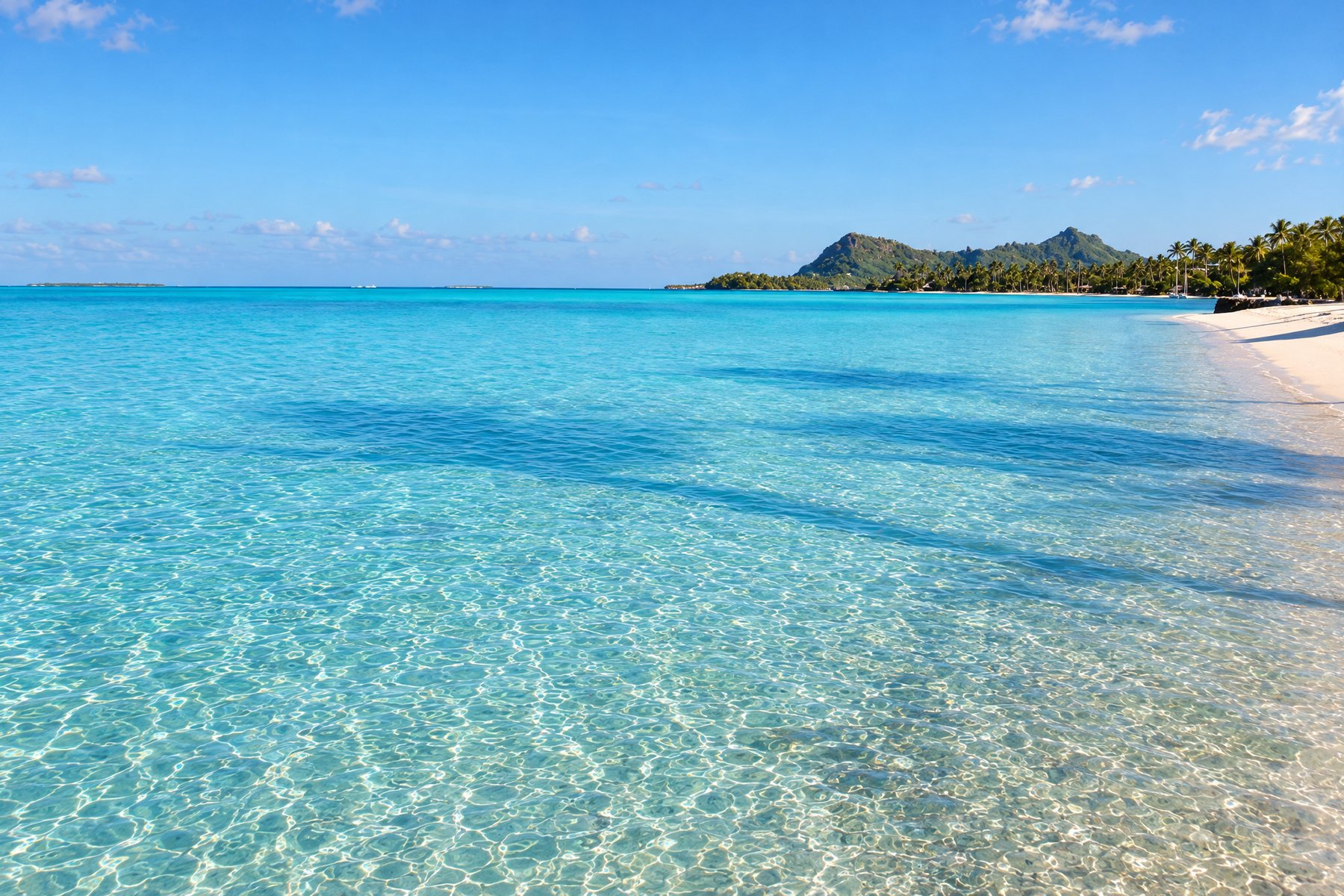
Matira, the island's one public beach
Islands · Bora Bora · Best time to visit
The short answer: May, September and October. They sit in or at the edge of the dry season, and in the twelve months to July 2026 Bora Bora's international hotels charged 11 to 18% less in them than in August1234. July and August are the driest and the dearest. February and March are the cheapest and the wettest.
01 · The short answer
Dry, cheap, quiet:
pick two.
Bora Bora has no bad month for temperature: mean highs stay between 28.9 and 31.4 °C all year, and the sea between 26.9 and 29.1 °C56. The choice is about three other things: how much rain you can live with, what you are willing to pay, and how many other people you want at Matira.
Rain splits the year. July to September average 62 to 65 mm a month; December and January about 245 to 251 mm5. Prices follow demand more than weather. In the twelve months to July 2026 the island's international hotels averaged 145,992 XPF (≈ US$1,431) per room-night in August 2025 and 102,956 XPF (≈ US$1,009) in February 2026, before tax17. That is about 30% between the dearest and the cheapest month, for the same rooms.
Occupancy tells you about crowds: 43.6% of rooms were let in January 2026, 76.6% in June 202689. Tahiti Tourisme calls June to September the high season, with July and August the peak, and November to March the low season10.
The compromise months are where the curves cross. September brings dry-season weather (64.6 mm of rain in a normal year)5, and in 2025 its hotels averaged 119,287 XPF (≈ US$1,169) a room-night2. May and October get 109 to 112 mm of rain, about half a wet-season month, at 125,000 to 130,000 XPF543.
02 · By priority
Match the month
to the reason.
- Driest weather
- July, August, September: 61.9–64.6 mm of rain a month and 8.8–9.4 rain days5July and August are also the dearest
- Lowest hotel prices
- February and March: 102,956 and 108,997 XPF a room-night in 2026, the year's lowest711Also the wet season: 168–212 mm a month
- Fewest people
- January: 43.6% of international-hotel rooms let in 2026; February 49.5%87Its first ten days are Polynesian school holidays12
- Whales
- August to October. Permits around Bora Bora run 20 July–20 November; humpbacks are around from July to the end of October13The whales page covers the islands that specialise
- Diving and mantas
- Any month. The mantas at Anau and the lemon sharks at Tapu are not tied to a season in Tahiti Tourisme's guide14Warmest water March–April, 29.1 °C
- The Heiva
- July: the Heiva i Bora Bora runs for the month on Tuvavau square in Vaitape15Peak month for prices too
- Avoiding cyclone risk
- May to October; the season runs November to April, sometimes into May16
- Avoiding school holidays
- 3–14 May, 24 May to the end of June, early October and 9 November–11 December miss the French and Polynesian school breaks of 2026–2712Dates in section 08
03 · What the hotels charged
Hotel prices
through the year.
- January 2026
- 109,025 XPF (≈ US$1,069), 43.6% let8
- February 2026
- 102,956 XPF (≈ US$1,009), 49.5% let7The year's lowest rate
- March 2026
- 108,997 XPF (≈ US$1,069), 58.3% let11
- April 2026
- 127,501 XPF (≈ US$1,250), 67.6% let17
- May 2026
- 125,440 XPF (≈ US$1,230), 69.4% let4
- June 2026
- 141,032 XPF (≈ US$1,383), 76.6% let9The year's highest occupancy
- July 2026
- 145,022 XPF (≈ US$1,422), 76.1% let18
- August 2025
- 145,992 XPF (≈ US$1,431), 74.6% let1The year's highest rate
- September 2025
- 119,287 XPF (≈ US$1,169), 75.4% let2
- October 2025
- 130,161 XPF (≈ US$1,276), 75.6% let3
- November 2025
- 113,139 XPF (≈ US$1,109), 62.3% let19
- December 2025
- 110,164 XPF (≈ US$1,080), 59.0% let20
04 · Reading the price table
What those
averages mean.
The figures are ISPF's monthly survey of Bora Bora's international hotels: the average price actually paid per room-night let, before tax, and the share of rooms let18. Over all of 2025 the average was 119,013 XPF (≈ US$1,167) and occupancy 68.4%21.
An average is not a quote. It mixes garden rooms with overwater villas, and it moves with the hotel stock: the Conrad reopened on 1 May 2026 after renovation, and the InterContinental Thalasso closed on 1 June 2026, to return as the Regent in late 20272223. Use the table for the shape of the year, not for the price of a particular room. For the whole trip budget, see what Bora Bora costs; for the rest of the country's seasons, when to go.
Pensions are outside the survey and move less. Village Temanuata at Matira publishes one year-round rate, 27,000 to 32,000 XPF (≈ US$265–314) per bungalow for two plus taxes, and discounts through free nights instead: stay two nights and pay one in January–February, three for two (or six for four) in November–December, four for three in September–October2425.
05 · Month by month
Month
by month.
Rain is the 1991–2020 normal at the airport5; hotel rates are the ISPF averages above, before tax. School-holiday dates are for 2026–2712.
January
Quietest, wet, good value
The emptiest hotels of the year (43.6% let in 2026) at about 109,000 XPF8, but 245 mm of rain over 17 days and the cyclone season. Polynesian Christmas holidays run to 10 January12. Pensions give the deepest deals: two nights for one at Temanuata25.
February
Cheapest month
The lowest average rate, 102,956 XPF in 20267, and the second-wettest normal after December and January: 211.5 mm5. Polynesian schools break 13–21 February 202712. For a flexible traveller who will trade a rainy afternoon for the price.
March
Hot, cheap, still wet
Rates stay low (108,997 XPF in 2026, 58% let)11; rain eases to 168 mm. The warmest sea of the year, 29.1 °C6. Polynesian Easter holidays start on 27 March 202712.
April
Shoulder, warm water
Prices jump to about 127,500 XPF and occupancy to 68%17; rain falls to 144 mm over 11.8 days5. French spring holidays (3 April–2 May 2027, by zone) and Polynesian Easter holidays to 11 April add families12. Late April is the better half.
May
Our pick of the first half
The cooler season begins: 112 mm of rain over 11 days5, the sea still 28.7 °C6, hotels at 125,440 XPF and 69% let4. Avoid the Polynesian school break of 15–23 May 2027 if you want the quietest weeks12.
June
Dry, busy, near-peak prices
85.5 mm of rain5 and the year's highest occupancy, 76.6%, at 141,032 XPF9. Tahiti Tourisme's high season starts here10. Book early; June buys almost July weather without the school holidays.
July
Heiva, holidays, peak
The driest month (61.9 mm)5, the Heiva on Tuvavau square all month15, and French and Polynesian summer holidays from early July12. Hotels averaged 145,022 XPF at 76% let in 202618. Go for the Heiva; otherwise pay for it.
August
Dry, windy, dearest
63.7 mm of rain and the fewest rain days5, and the highest average rate of the twelve months: 145,992 XPF in 20251. Whale permits are running13. Polynesian schools go back around 23–24 August, French ones at the start of September12.
September
Our pick overall
As dry as July and August in a normal year (64.6 mm)5, whales around the islands13, and in 2025 the cheapest dry-season month, 119,287 XPF, though 75% let2. Temanuata's four-for-three offer starts25. Book: September is no secret.
October
Shoulder, warming
Rain returns to 108.7 mm5; hotels averaged 130,161 XPF at 76% let in 20253. The last weeks of whale season13. Polynesian holidays from 24 October and French ones from 17 October, to early November12.
06 · By kind of trip
Five trips,
five sets of dates.
The overwater room on a budget
February, March or November, when averages fell to 102,956–113,139 XPF71119. When the room is the trip, a wet afternoon costs less. Take a refundable rate.
With children
School holidays usually decide. If they don't, the cool season is easier on small children: 3.8 days reach 30 °C in an average July, 27.5 in March5. Matira's shallow water works all year.
On a pension budget
Rates barely move, so chase the free-night offers (two-for-one in January–February at Temanuata)25 and the term-time ferry fare from Tahiti, 8,000 XPF instead of 9,00026.
07 · Honeymoon dates
When the date
is already fixed.
Honeymoons don't always get to choose the month. If the wedding sets the date, here is what each part of the year means on Bora Bora.
May to October is the safe window for weather: the cool, less humid season, outside the cyclone months2716. Within it, June to August costs most: hotel averages of 141,000 to 146,000 XPF a room-night in 2025–26, against 119,000 to 130,000 in September and October9123. A late-summer wedding followed by a September honeymoon is the easiest saving.
November to April is warmer, emptier and cheaper, and wetter: January averages 17 rain days5. For an overwater room the rain matters less than for a trip built around boats and beaches, but the wet season is also the cyclone season16. On wet-season dates, take refundable rates and put a buffer night on Tahiti before the international flight.
Whatever the month, the bigger decisions are the room and the split of the stay: which way an overwater room faces, how far out it sits, and whether three nights over the water and two on the beach beat five over the water. Those are on the honeymoon page.
08 · Festivals and holidays
The Heiva,
and whose holidays.
In July Tuvavau square in Vaitape, sand-covered for the occasion, stages the Heiva i Bora Bora: a month of dance and song competitions15. It is the island's main event and a good reason to go in July. It also lands on the most expensive, most crowded weeks: 76% of hotel rooms let at an average of 145,022 XPF in July 202618.
Two school calendars matter. French visitors made up 36% of French Polynesia's tourists in July–September 2025, North Americans 33%28, so France's holidays shape the peaks: summer from 3 July 2027, autumn 17 October–1 November 2026, Christmas 19 December–3 January, and spring breaks staggered by zone between 3 April and 2 May 202712.
French Polynesia's own calendar fills pensions, ferries and inter-island flights with residents: 24 October–8 November 2026, 12 December–10 January, 13–21 February, 27 March–11 April and 15–23 May 2027, then from early July to about 23 August12. The Apetahi Express ferry from Tahiti costs 8,000 XPF one way in school term and 9,000 XPF in holidays26.
One more crowd to plan around: cruise passengers, capped by the commune at 1,200 a day since 201929. On ship days the Vaitape quay and Matira are busier; the hotels and the motu are not.
09 · Booking around the season
How to book
by the calendar.
- 01
- 02
Take the shoulder weeks
The last week of April and May, and September to mid-October, give you most of the dry season's weather at shoulder rates. Check the school-holiday dates above before fixing the week.
- 03
In the wet season, stay flexible
From November to April, book refundable rooms and keep a spare day: a lagoon tour can be moved, a cyclone alert cannot. Keep a buffer night on Tahiti before the flight home.
- 04
Use free-night offers
Pensions discount by free nights rather than lower rates; Temanuata's run from two-for-one in January–February to four-for-three in September–October25. Ask the resorts for their equivalent.
- 05
Plan the boat days, not the beach days
If a lagoon tour or a dive is the point, put it early in the stay so weather can push it back a day. The weather page has the rain and wind by month.
10 · Questions
Questions.
- 01
- 02
- 03
- 04
- 05
- 06
When can you see whales at Bora Bora?
Humpbacks are around the islands from July to the end of October, and whale-watching permits at Bora Bora run from 20 July to 20 November, 07:30–17:3013.
- 07
When is the Heiva i Bora Bora?
In July, for the month, on Tuvavau square in Vaitape15.
- 08
Which month has the best weather?
For dry weather, July to September: 61.9–64.6 mm of rain a month and fewer than ten rain days5. They are also the coolest months by day, with highs around 29 °C.
- 09
- 10
Sources · last verified 19 October 2026(29)
- ISPF: Fréquentation hôtelière — août 2025 (indicators by subdivision: Bora Bora RMC before tax, occupancy) ↗
- ISPF: Fréquentation hôtelière — septembre 2025 (indicators by subdivision: Bora Bora) ↗
- ISPF: Fréquentation hôtelière — octobre 2025 (indicators by subdivision: Bora Bora) ↗
- ISPF: Fréquentation hôtelière — mai 2026 (indicators by subdivision: Bora Bora) ↗
- Météo-France: Fiche climatologique — Bora-Bora-Motu-Aero (98714002, alt. 3 m), statistiques 1991–2020 et records ↗
- seatemperature.info: Bora Bora water temperature — monthly averages, 10 years of satellite and in-situ data ↗
- ISPF: Fréquentation hôtelière — février 2026 (indicators by subdivision: Bora Bora) ↗
- ISPF: Fréquentation hôtelière — janvier 2026 (indicators by subdivision: Bora Bora) ↗
- ISPF: Fréquentation hôtelière — juin 2026 (indicators by subdivision: Bora Bora) ↗
- Tahiti Tourisme: When to visit The Islands of Tahiti (high season June–September, low season November–March) ↗
- ISPF: Fréquentation hôtelière — mars 2026 (indicators by subdivision: Bora Bora) ↗
- Ministère de l'Éducation nationale: Calendrier scolaire 2026–2027 (zones A, B, C and Polynésie), open data ↗
- Direction de l'environnement (DIREN), Polynésie française: Comment observer les mammifères marins en Polynésie française (humpbacks July–end October; permits around nine islands incl. Bora Bora, 20 July–20 November, 07:30–17:30; May 2025) ↗
- Tahiti Tourisme: Diving in Bora Bora (Anau mantas, Tapu lemon sharks) ↗
- Tahiti Tourisme: Things to do in Bora Bora (Heiva i Bora Bora: month-long, July, Tuvavau square, Vaitape) ↗
- Météo-France Polynésie: Qu'est-ce qu'un cyclone ? (southern-hemisphere season: November to April, sometimes May) ↗
- ISPF: Fréquentation hôtelière — avril 2026 (indicators by subdivision: Bora Bora) ↗
- ISPF: Fréquentation hôtelière — juillet 2026 (indicators by subdivision: Bora Bora; RMC defined as before tax) ↗
- ISPF: Fréquentation hôtelière — novembre 2025 (indicators by subdivision: Bora Bora) ↗
- ISPF: Fréquentation hôtelière — décembre 2025 (indicators by subdivision: Bora Bora) ↗
- ISPF: Tableau de bord du tourisme 2025 (annual hotel indicators by island: Bora Bora RMC 119,013 F.CFP, CMR 68.4%) ↗
- Travelling for Business: Conrad Bora Bora Nui to reopen on 1 May 2026 ↗
- IHG: Regent Hotels & Resorts to debut in French Polynesia with signing of Regent Bora Bora (16 Sep 2026) ↗
- Village Temanuata: Village Temanuata — internet rates (per bungalow for two; 13% VAT + 1% social VAT and tourist tax not included; undated) ↗
- Village Temanuata: Village Temanuata — special offers by season (undated) ↗
- Tuatea Ferries / Apetahi Express: Tarifs Apetahi Express (période scolaire / vacances) ↗
- Météo-France Polynésie: Climat de la Polynésie (seasons in the Society Islands) ↗
- ISPF: Tableau de bord du tourisme — 3e trimestre 2025 (visitors by market) ↗
- Cruise Industry News: Islands of Tahiti position to small and medium-sized cruise ships (Bora Bora: 1,200 cruise passengers a day, set by the commune in 2019) ↗