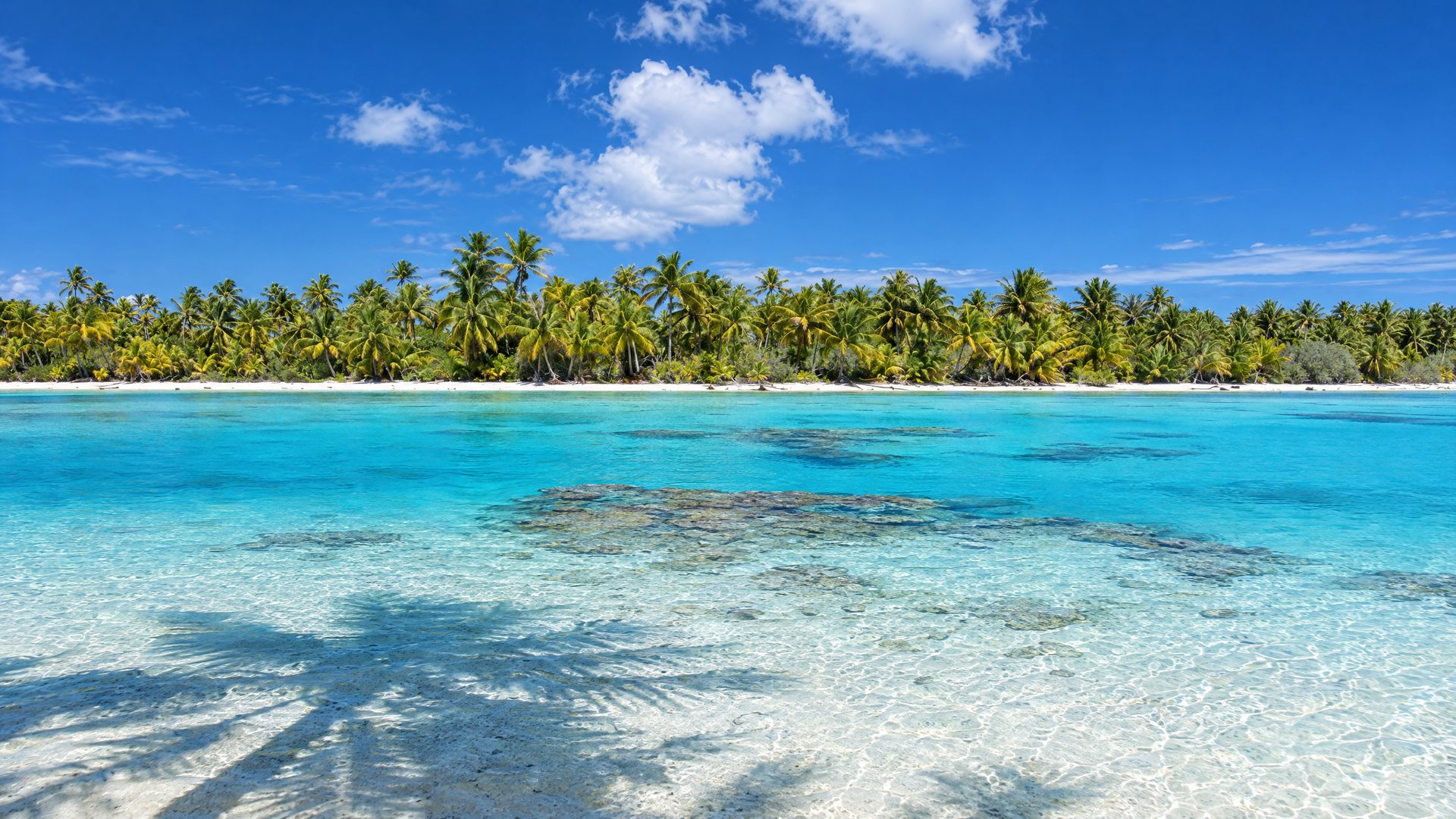
Tuamotu
Fakarava,
the biosphere
reserve.
A UNESCO biosphere reserve that is almost entirely sea, with a wall of grey reef sharks in the south pass, one village in the north, and a paved road between.
Fakarava's lagoon
Two passes. Garuae in the north, 1.6 km wide, the widest in French Polynesia. Tumakohua in the south, 200 m wide and 12 m deep, with the sharks. In between: 949 people, one paved road, four groceries, a bakery, and a supply ship every seven to ten days.
01 · The south pass
Several hundred
sharks, one gate.
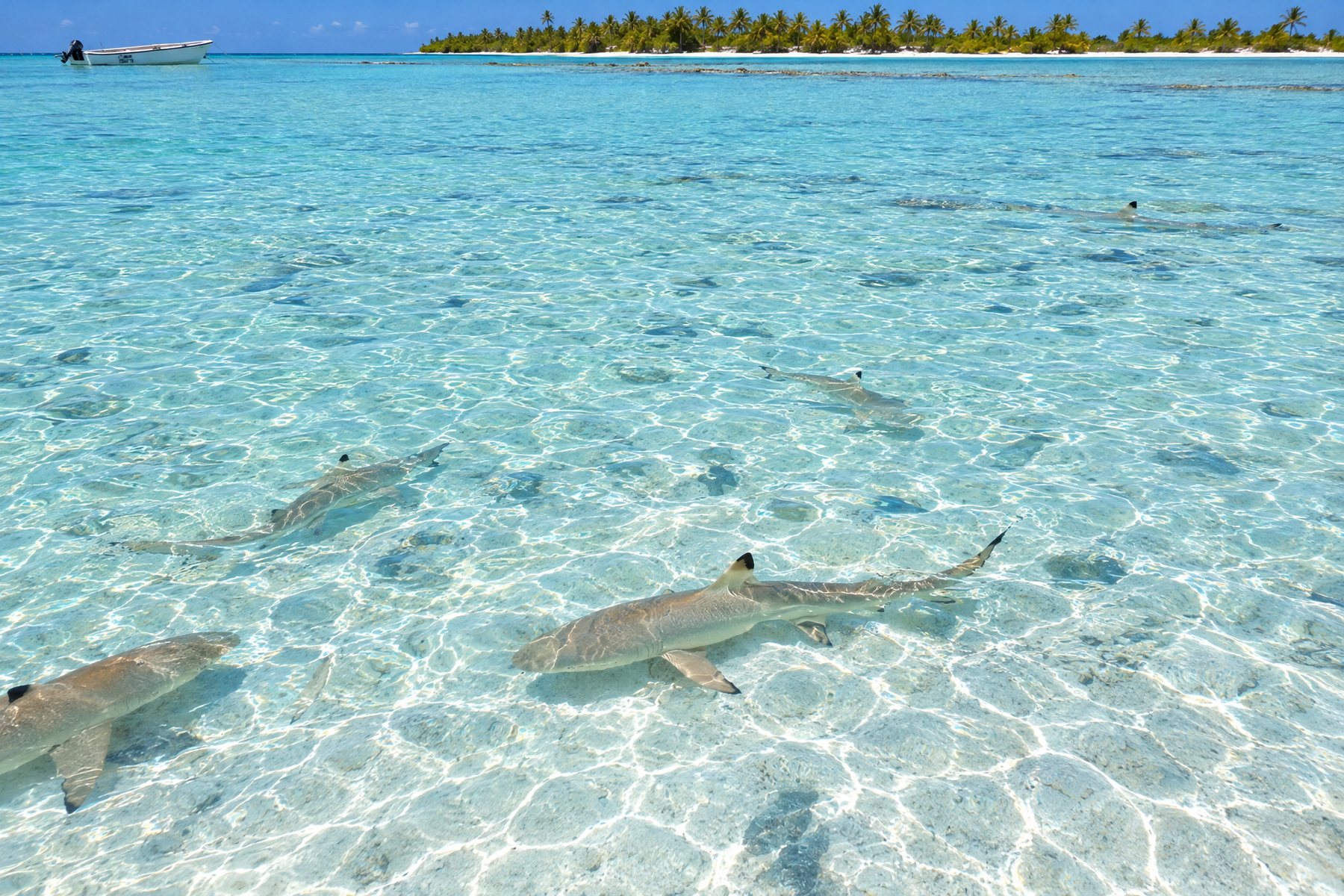
Scientists counted about 700 grey reef sharks in Tumakohua in 2014, and a later study put the peak at up to 900 around the full moons of June and July, when some 17,000 groupers gather in the pass to spawn and the sharks come to the feast. It is one of the densest shark populations anywhere, and it exists because the whole atoll sits inside a biosphere reserve where nobody fishes them.
You do not need to dive to see it. On an incoming tide the pass is shallow enough to watch the wall from the surface with a mask, and Tetamanu Village runs accompanied snorkels with a safety boat. Do not take a dinghy into the pass on your own. Diving here is limited by quota and only with an approved Fakarava club; the north's Garuae is wider, deeper in the middle, and rated by many divers above the south for sheer fish density, with an outgoing current that can reach eight knots in the trade-wind months.
Tetamanu itself is the old village: a coral-stone church from 1874 where mass is still said on Sundays, a pension, a dive club and very little else. Showers are cold. Most people come for the sharks and leave by boat.
02 · Three Fakaravas
Sharks, stone,
and pink sand.
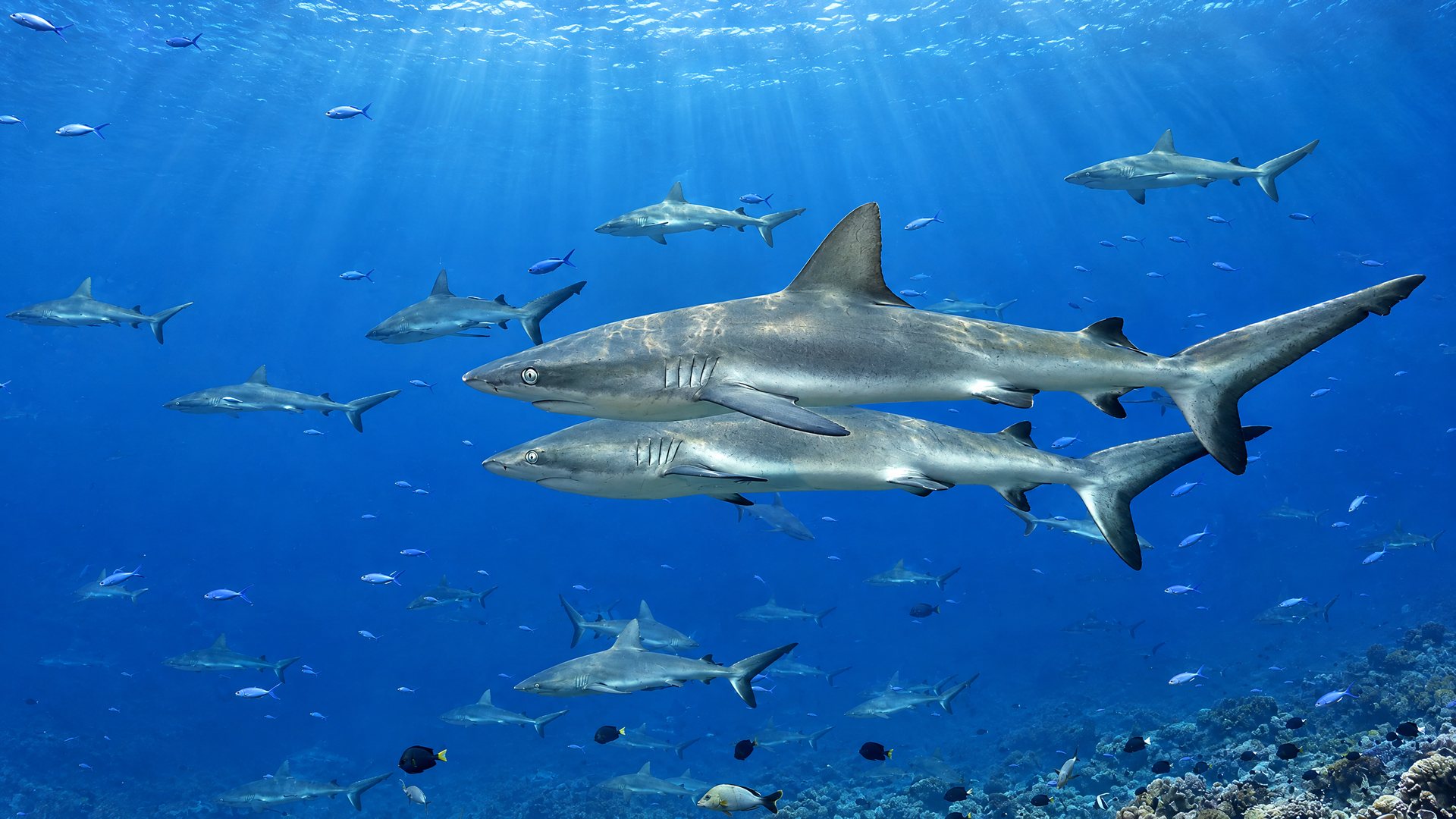
The wall
Tumakohua on an incoming tide, from the surface or from the blue. The June–July spawning is the spectacle; the sharks are there all year.
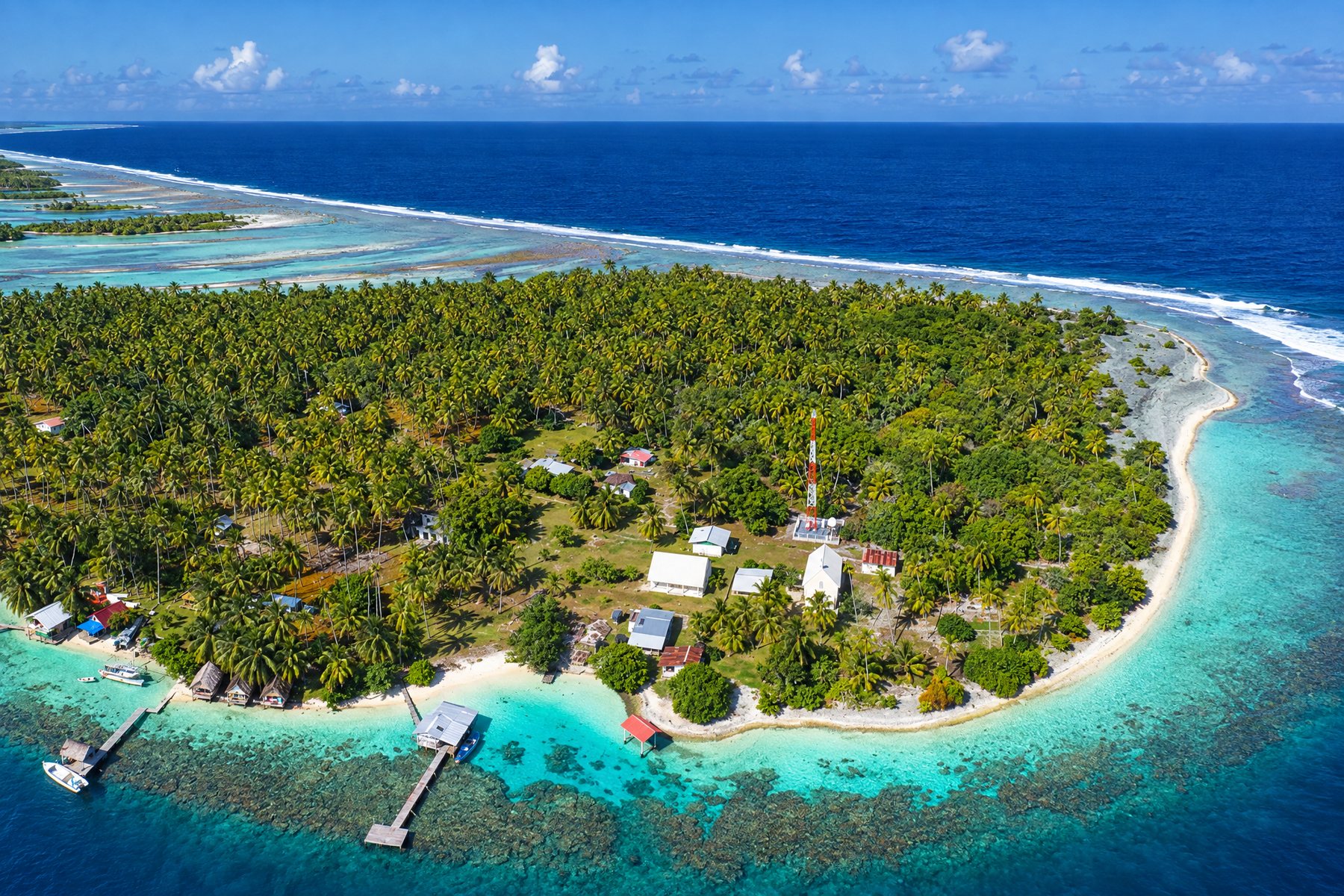
Tetamanu
The 1874 church, the jetty, the pass on the doorstep. An hour to an hour and a half by boat from the village, and worth two or three nights.
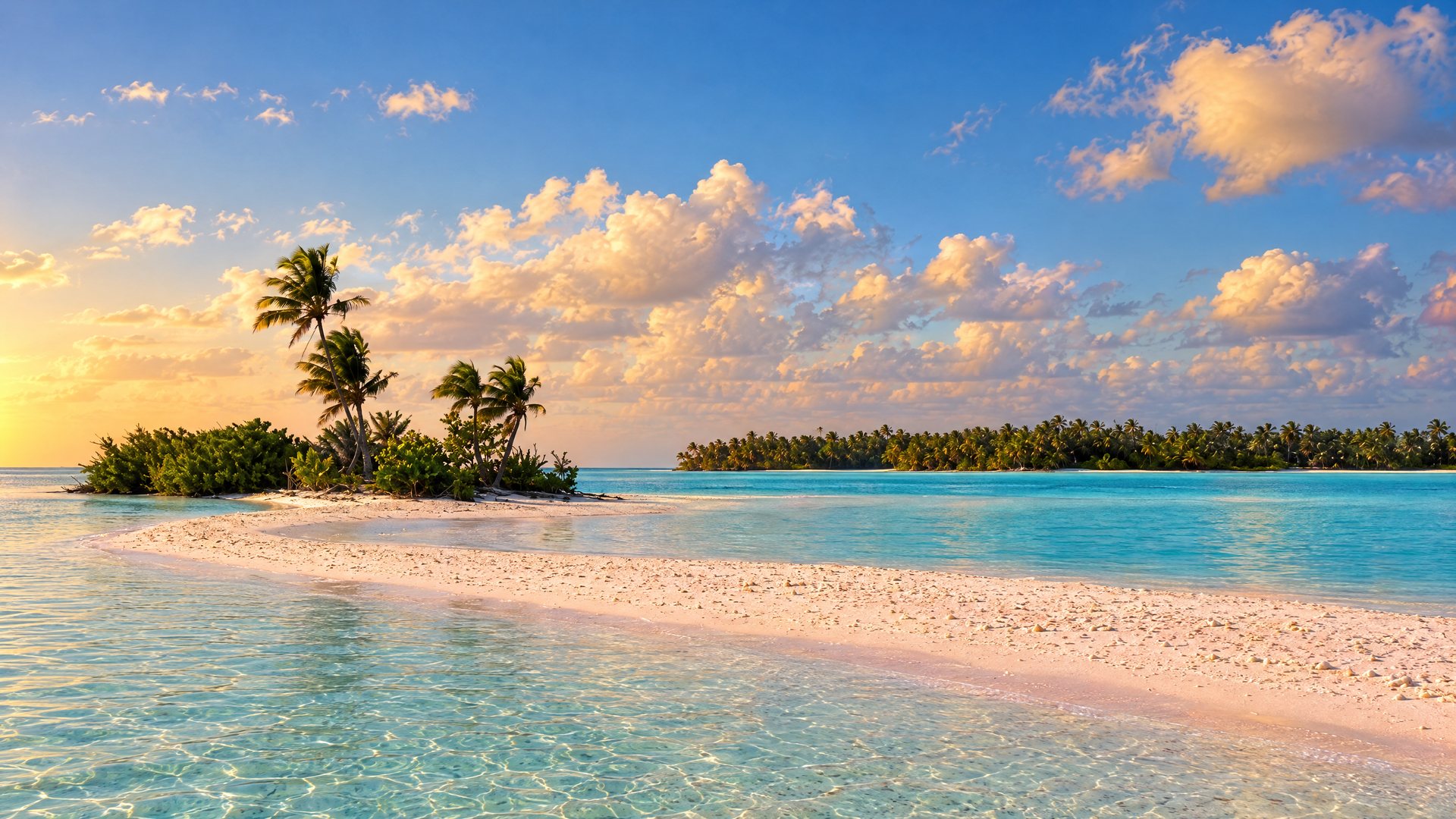
Les Sables Roses
The pink sands near the south end: a strict reserve with no anchoring, no camping, no fires, reached only by dinghy or with an operator. Take everything away.
03 · Where to stay
North for the road,
south for the sharks.
Rotoava, the village in the north, has the quay, the shops, most dive clubs, the airport four kilometres away and Garuae a short ride off. Havaiki Lodge there has beach and garden bungalows with half board, bikes, kayaks and its own pearl farm, roughly 28,000 to 40,000 XPF for two. Pensions string along the paved road south of the village: Tokerau Village seven kilometres out with four lagoon-side bungalows and hot water, Vekeveke Village with eight. The dive clubs collect divers from the north at no charge.
The far end is another world. Tetamanu Village sits on the south pass with bungalows facing it and its own dive club. Raimiti, on Motu Tetapiri near Hirifa, has nine bungalows, no wifi, boat outings included and advice against children under about three. Hirifa itself has a kite school from April to October. Hei O Fakarava rents a safari tent in the middle of Rotoava for the cheapest bed on the atoll. Yachts book overnight anchorages on the government's escales site and pay a small tourist tax to the town hall.
04 · Know before you go
The practical
part.
- Getting there
- Air Tahiti from Tahiti in 1 h 10, every day in the summer timetable, return fares from 45,760 XPF in October 2026. Direct from Rangiroa daily, but back only on Mondays, so do Rangiroa first. Also direct from Tikehau, Bora Bora and Moorea.No ferry; supply ships every 7–10 days
- Getting around
- A bike on the one paved road, from the airport through Rotoava and 15 km south. Fakarava Yacht Services rents bikes, e-bikes and e-scooters. Everything beyond the road is by boat.Pensions collect you from the airport
- Water
- Houses run on brackish groundwater, fine for showers. Drink rainwater from tanks or bottled water.Fresh produce is scarce between ships
- Best window
- June to October are driest, 65–122 mm a month at the nearest station; June and July add the spawning and the crowds. December and January are wettest.Book south-pass beds early for the full moons
- Money
- One ATM. Bring cash. Half board at the pension removes most other spending.Pearls: compare with Papeete
- Land
- The Topaka lighthouse north of the village, a stepped coral pyramid from 1957; the older light behind the town hall; old ovens for drying sea cucumbers near Garuae. That is the extent of the sightseeing on land.There is no hiking on an atoll
05 · How to plan it
Four steps.
- 01
Three or four nights in the north
Garuae, the village, the Lagon Bleu, a bike every day.
- 02
Two or three in the south
The pass at Tetamanu or the quiet at Raimiti. Or a day trip from the north if beds are gone.
- 03
Time it to the moon
If the groupers are the point, be here for the June or July full moon, and book months ahead.
- 04
Keep a spare day
Wind cancels dives and occasionally boats, and the flight home does not wait.
06 · Who it does not suit
No resort,
slow wifi.
There is no beach bar, no choice of restaurants, no nightlife, and the far end of the atoll is a long boat ride away. Non-divers who do not snorkel may find three days plenty. People who need fresh fruit every day should know the shops depend on a ship. For divers and snorkelers who can handle a drift, it is the best few days in the country.
07 · Who it suits
Who it
suits best.
Known for: Two passes: Garuae, 1.6 km wide, and Tumakohua, 200 m · The grey-reef-shark wall and the June–July grouper spawning · A UNESCO biosphere reserve that is almost all sea · Family pensions, half board and bicycles · Pink sands and the old village of Tetamanu.
Divers first: the two passes are the reason most people come, and six dive clubs work them. Snorkelers who can handle a drift do well too — the south pass is shallow enough to watch the sharks from the surface. It also suits anyone who wants a quiet atoll with just enough infrastructure: a paved road, a few groceries, a bakery and pensions that feed you.
Typical stay: 5–7 nights. Long enough to split the stay between Rotoava and the south pass, and to keep a spare day for a dive or boat trip lost to wind or current.
08 · Getting there and around
Getting there,
getting around.
- International
- All international flights land at Faa'a (PPT) on Tahiti. Air Tahiti's minimum connection is 90 minutes from an international to a domestic flight and 120 minutes the other way.1
- Domestic flights
- Air Tahiti flies Tahiti–Fakarava (453 km) in 1 h 10. The summer 2026 timetable (29 March–24 October) has flights every day, one to three a day, some stopping at another atoll; there are also direct links from Rangiroa (daily), Tikehau, Bora Bora and Moorea. Return fares from 45,760 XPF (≈ US$449) on Air Tahiti's site, October 2026.2
- Cargo ships
- Supply ships reach the atoll every 7 to 10 days, and fresh produce is short in between. Treat them as freight, not transport.3
- Cruise ships
- Windstar, the Paul Gauguin, Aranui and Variety Cruises include Fakarava on some itineraries.4
- Yachts
- Yachts must book a night anchorage (16:00–09:00) on escales.gov.pf; each zone has a quota and a 48-hour or 7-day limit, and the Rotoava town hall collects a tourist tax of about 60 XPF (≈ US$0.60) per person per day (indicative, 2025).3
- Airport transfer
- The airport is 4 km from Rotoava with no taxis; pensions collect their guests. Ask when you book, especially if you're staying down the south road.4
- Bikes & e-bikes
- The only paved road runs from the airport through Rotoava and about 15 km south past the pensions — flat, and made for a bike. Several pensions lend bikes; Fakarava Yacht Services in Rotoava rents bikes, e-bikes and e-scooters (Monday–Saturday, 08:00–17:00).5
- Cars
- Cars can be rented in Rotoava, but on a single road of this length a bike does most jobs.4
- Boats
- Everything beyond the road is by boat: Rotoava to Tetamanu takes about an hour by Tahiti Tourisme's estimate, 1 h 30 by the dive clubs' and the south-end pensions'. The dive clubs collect divers from pensions in the north at no charge.4
09 · Where to stay
Which side
of the island.
Rotoava & the north. The village, the quay, the shops and most of the dive clubs, with Garuae pass and the airport a short ride away. Everything a stay needs, at bicycle distance. Best for: First stays, divers on a budget, no-boat trips.
The south road. Pensions strung along the lagoon side of the paved road, 4–7 km south of the village. Quieter, with snack bars and a dive club near Vekeveke Village; a bike becomes part of daily life. Best for: Lagoon-front bungalows, longer stays.
Tetamanu & the south pass. The old village by Tumakohua pass: a coral church from 1874, a pension, a dive club and very little else. Showers are cold; most people come for the sharks and leave by boat. Best for: Divers, snorkelers, two or three nights.
Hirifa & the south-east. Sheltered anchorage, a seasonal kite school, the pink sands nearby, and Raimiti on Motu Tetapiri, 1 h 30 by boat from Rotoava. No Wi-Fi; 4G works. Best for: Getting away from everything, including the village.
10 · Accommodation
Beds,
by budget.
- Pensions & guesthouses
- The atoll's standard. Havaiki Lodge, in Rotoava, has beach and garden bungalows with half board, bikes and kayaks, and its own pearl farm. Tokerau Village, about 7 km south of the village, has four lagoon-side bungalows with hot water; Vekeveke Village has eight, 4 km from Rotoava. Examples: Havaiki Lodge, Tokerau Village, Vekeveke Village.6Havaiki Lodge: ≈ 28,000–40,000 XPF (≈ US$275–390) per bungalow for two per night, half board (rates posted in euros, €237–334; undated, checked October 2026)
- South-pass & remote pensions
- Tetamanu Village sits on the south pass with bungalows facing it, a restaurant deck and its own dive club; showers are cold water. Raimiti, on Motu Tetapiri near Hirifa, has nine bungalows, no Wi-Fi, and boat outings included — only diving is extra, through Enata Fakarava Diving at the south pass. Raimiti advises against children under about three. Neither publishes rates online. Examples: Tetamanu Village, Raimiti.7
- Budget
- Hei O Fakarava rents a safari tent for up to five in the middle of Rotoava, open all year in 2026, meals not included. Rates on request. Examples: Hei O Fakarava.8
- Sailboats
- Charter yachts and cabin cruises (Sunsail, Azuline Charter, Voilier Kanaga among those Tahiti Tourisme lists) use the atoll as a base, anchoring off Rotoava, Hirifa and Tetamanu. Examples: Sunsail, Voilier Kanaga.9
11 · In the water
Beaches, reef
and open water.
- Garuae (north pass)
- 1,600 m wide and about 10 m deep in the middle. Grey reef sharks for most of the dive, with fish density to match; many divers rate it above the south pass. With the south-east trade wind (June–September) the outgoing current can reach 8 knots, so the clubs time dives to the incoming tide.3Diving
- Tumakohua (south pass)
- 200 m wide and 12 m deep, with a sill at 4 m. Its grey reef sharks were estimated at about 700 in 2014; the 2016 study put the peak at up to 900, when some 17,000–18,000 groupers gather to spawn around the June–July full moons. Diving here is quota-limited and only with an approved Fakarava club.10Diving
- Learning to dive
- O2 Fakarava's rates from 1 June 2026 to 31 May 2027: one dive 10,900 XPF (≈ US$107), falling to 9,200 XPF (≈ US$90) from ten dives; introductory dive 15,000 XPF (≈ US$147); a south-pass day adds 15,000 XPF (≈ US$147) per person for the boat and lunch. Nitrox, equipment and pick-up in the north included.11Diving
- South-pass drift
- The pass is shallow enough to watch the sharks from the surface on an incoming tide. Tetamanu Village runs accompanied snorkels with a safety boat; don't take a dinghy into the pass on your own.3Snorkeling
- Lagon Bleu
- A natural pool reached by boat from the north of the atoll with a local operator for a day of grilled fish and snorkeling. Shallow and calm — the easiest water on the atoll for children and beginners.3Lagoon
- Les Sables Roses
- The pink sands near the south end are a strict nature reserve: no anchoring, no camping, no fires, and access only by dinghy or with an operator. Take all rubbish away.3Beach
- Hirifa kite school
- A kite, wing, foil and wake school works at Hirifa from April to October, when the trade winds are steadiest.3Lagoon
12 · On land
Ashore,
between swims.
- 01
Topaka lighthouse
Viewpoint. The stepped pyramid north of the village, built in February 1957 of coral stone and cement: 14.2 m high, ten tiers. It once guided fishermen and yachts by day and night.3
- 02
Old Taputavaka lighthouse
Culture. The older, smaller light in Rotoava, ocean side, behind the town hall: coral blocks joined with lime, about 80 years old.3
- 03
Rori ovens near Garuae
Archaeology. Old ovens once used to dry sea cucumbers (rori) for export, near the north pass.3
- 04
Tetamanu church
Culture. The coral church of the abandoned south-pass village, built in 1874. Mass is still said there on Sundays.3
- 05
Havaiki pearl farm
Culture. The lodge's own farm offers visits to see grafting and harvest; ask at the front desk.6
13 · Food and shopping
What to eat,
and where.
Most visitors eat at their pension, usually on half board, and the set dinner is generally fish from the lagoon. Rotoava adds a handful of snacks and lounges, mostly open at lunchtime; book dinner anywhere outside your pension the day before. The four groceries and the bakery are small, fresh produce is scarce between supply ships, and the brackish tap water is for showering — drink rainwater or bottled water.
Shopping. Small: a few craft stalls in Rotoava and pearls sold by the farms themselves (Havaiki has its own). Pearl farming here has shrunk, and the Tuamotu as a whole grow most of the country's pearls, so compare with Papeete before spending seriously.
14 · Trip styles
One island,
several trips.
- Families
- Workable for confident swimmers. The Lagon Bleu is calm and shallow, bikes suit the flat road, and Havaiki and Tokerau Village take families. The south-end pensions are rougher — cold water, no shops, a long boat ride — and Raimiti advises against toddlers. There is an infirmary in Rotoava; serious cases fly to Tahiti.
- Honeymoons
- No resort, no overwater bungalows. Couples choose between a beach bungalow near the village and a few nights at the south pass or Raimiti, where the atmosphere is the luxury and the showers are not.
- On a budget
- Flights cost more than to Rangiroa, and pensions here are not cheap, but half board removes most other spending. Camp in Rotoava, ride a bike, and pay for a few dives rather than a south-pass day if money is tight.
- Nightlife
- There is none to speak of. Snacks close after lunch, pension dinners end early, and the evening entertainment is the stars.
15 · Weather by month
Month by month.
January
31° / 26° · sea 29°
Rain about 197 mm. Crowds low, prices moderate.
February
31° / 26° · sea 29°
Rain about 171 mm. Crowds low, prices moderate.
March
31° / 26° · sea 29°
Rain about 129 mm. Crowds moderate, prices moderate.
April
31° / 26° · sea 29°
Rain about 116 mm. Crowds moderate, prices moderate.
May
30° / 26° · sea 28°
Rain about 110 mm. Crowds moderate, prices moderate.
June
30° / 26° · sea 28°
Rain about 93 mm. Crowds peak, prices moderate.
July
29° / 25° · sea 27°
Rain about 65 mm. Crowds peak, prices high.
August
29° / 25° · sea 27°
Rain about 66 mm. Crowds high, prices moderate.
September
29° / 25° · sea 27°
Rain about 83 mm. Crowds high, prices moderate.
October
30° / 25° · sea 27°
Rain about 122 mm. Crowds high, prices moderate.
November
30° / 26° · sea 28°
Rain about 159 mm. Crowds low, prices moderate.
December
30° / 26° · sea 28°
Rain about 219 mm. Crowds moderate, prices moderate.
Takaroa (airport), about 190 km north-east — Météo-France normals 1991–2020; the nearest Tuamotu station with a published sheet12. Sea temperature13. Crowds and prices are editorial scores (1 = low, 5 = high). Crowds follow ISPF's 2024 monthly tourist-nights curve for French Polynesia (lowest January–February and November, peak July), raised in June and July for the grouper spawning, when divers fill the south-pass beds. Prices: the pension rates we found are not seasonal (Havaiki posts one rate for every day), so scores are flat apart from July..
16 · Trip length
How long,
and with what.
Five to seven nights: three or four in the north for Garuae and the village, two or three at the south pass or Hirifa. Fakarava pairs naturally with Rangiroa — in the summer 2026 timetable there is a direct Rangiroa–Fakarava flight every day but a direct flight back only on Mondays, so do Rangiroa first. Tikehau, Bora Bora and Moorea also have direct flights in. Keep a buffer night on Tahiti before the international flight: wind can cancel dives, and occasionally boats.
17 · Fakarava vs Rangiroa
Fakarava
or Rangiroa?
- Getting there
- Fakarava: 1 h 10 from Tahiti (453 km); 1–3 flights a day2
Rangiroa: 1 h (356 km); several flights a day14
Verdict. Rangiroa is easier and has more beds and passes on the doorstep; Fakarava is quieter and has the south pass. With a week, do both — Rangiroa first, because the direct flight runs that way every day. The Rangiroa guide
18 · Questions
Asked
before booking.
- 01
When is the shark and grouper spectacle?
Around the full moons of June and July, when thousands of groupers gather to spawn in the south pass and the grey-reef-shark numbers peak. Sharks are there year-round; book south-pass beds and dives early for those weeks.
- 02
Can I see the sharks without diving?
Yes. On an incoming tide the south pass is shallow enough to snorkel; go with Tetamanu Village or a dive club's boat rather than on your own.
- 03
Should I stay in Rotoava or at the south pass?
Both, if you can: the north has the shops, the road and Garuae; the south has the shark wall but a 1 to 1½-hour boat ride and fewer comforts. A day trip from the north to the south pass is the alternative.
- 04
Is the tap water drinkable?
No. Houses run on brackish groundwater, fine for showers; drinking water is rainwater from tanks or bought in bottles.
- 05
What is the best month to go?
June to October are the driest (65–122 mm a month at Takaroa, the nearest station) and the sea is slightly cooler; June and July add the spawning and the crowds. December and January are the wettest.
Sources · last verified 14 October 2026(26)
- Air Tahiti: Minimum connecting time ↗
- Air Tahiti: Programme des vols été 2026 (forecast timetable, 29 March–24 October 2026): Tahiti–Fakarava, Rangiroa–Fakarava, Tikehau–Fakarava, Bora Bora–Fakarava ↗
- Service du tourisme de la Polynésie française: Fakarava — informations aux plaisanciers (2025 edition, published January 2026): services, passes, lighthouses, dive clubs, anchorages ↗
- Tahiti Tourisme: Getting to Fakarava (airport 4 km from Rotoava, no taxi; boats; cruises; yacht charters) ↗
- O2 Fakarava: Fakarava pratique (road, services, water, health) ↗
- Havaiki Lodge: Havaiki Lodge — bungalows (beach €334, garden €237–291 per night for two, half board), pearl farm, services ↗
- Tahiti Tourisme: Raimiti (Fakarava) — open all year 2026 (updated 19 Aug 2025) ↗
- Tahiti Tourisme: Hei O Fakarava — camping, open all year 2026 (updated 17 Jun 2026) ↗
- Tahiti Tourisme: Where to stay in Fakarava ↗
- CNRS News: Fakarava's south pass: ~700 grey reef sharks (2014 estimate), up to 18,000 spawning groupers at the June full moon ↗
- O2 Fakarava: Tarifs du 01/06/2026 au 31/05/2027 ↗
- Météo-France: Fiche climatologique — Takaroa (98749001), statistiques 1991–2020 et records ↗
- seatemperature.info: Fakarava water temperature — monthly averages (aggregator) ↗
- Air Tahiti: Flights to Rangiroa (1 h, 356 km; fares from) ↗
- Air Tahiti: Flights to Fakarava (1 h 10, 453 km; airport; fares from) ↗
- ISPF: Recensement de la population 2022 — populations légales par commune et commune associée ↗
- Tahiti Tourisme: Rangiroa (villages, passes, accommodation types) ↗
- UNESCO: Commune de Fakarava — Man and the Biosphere Programme ↗
- ISPF: Le bilan du tourisme de l'année 2024 (Points Études et Bilans n° 1489) — monthly tourist nights ↗
- Tahiti Tourisme: Fakarava (overview, dive centres, points of interest) ↗
- Tahiti Tourisme: Where are The Islands of Tahiti? (time difference) ↗
- Phys.org: Massive numbers of reef sharks get by with a little help from their friends (Mourier et al., Current Biology, 2016: up to 900 sharks; spawning June–July) ↗
- Tetamanu Diving: Tetamanu Diving — Tetamanu Village & Sauvage ↗
- Pension Raimiti: Raimiti — FAQ (transfers, Wi-Fi, diving, children) ↗
- Tahiti Tourisme: Tokerau Village (Fakarava) (updated 17 Nov 2025) ↗
- Tahiti Tourisme: Vekeveke Village (Fakarava) (updated 7 Apr 2025) ↗
Related
Related pages.
Explained
The wall of sharks
Several hundred grey reef sharks in Fakarava's south pass, and the grouper spawning that feeds them.
Read the articleExplained
Why some sand is pink
The shells of foraminifera, single-celled organisms, ground into coral sand by the surf.
Read the article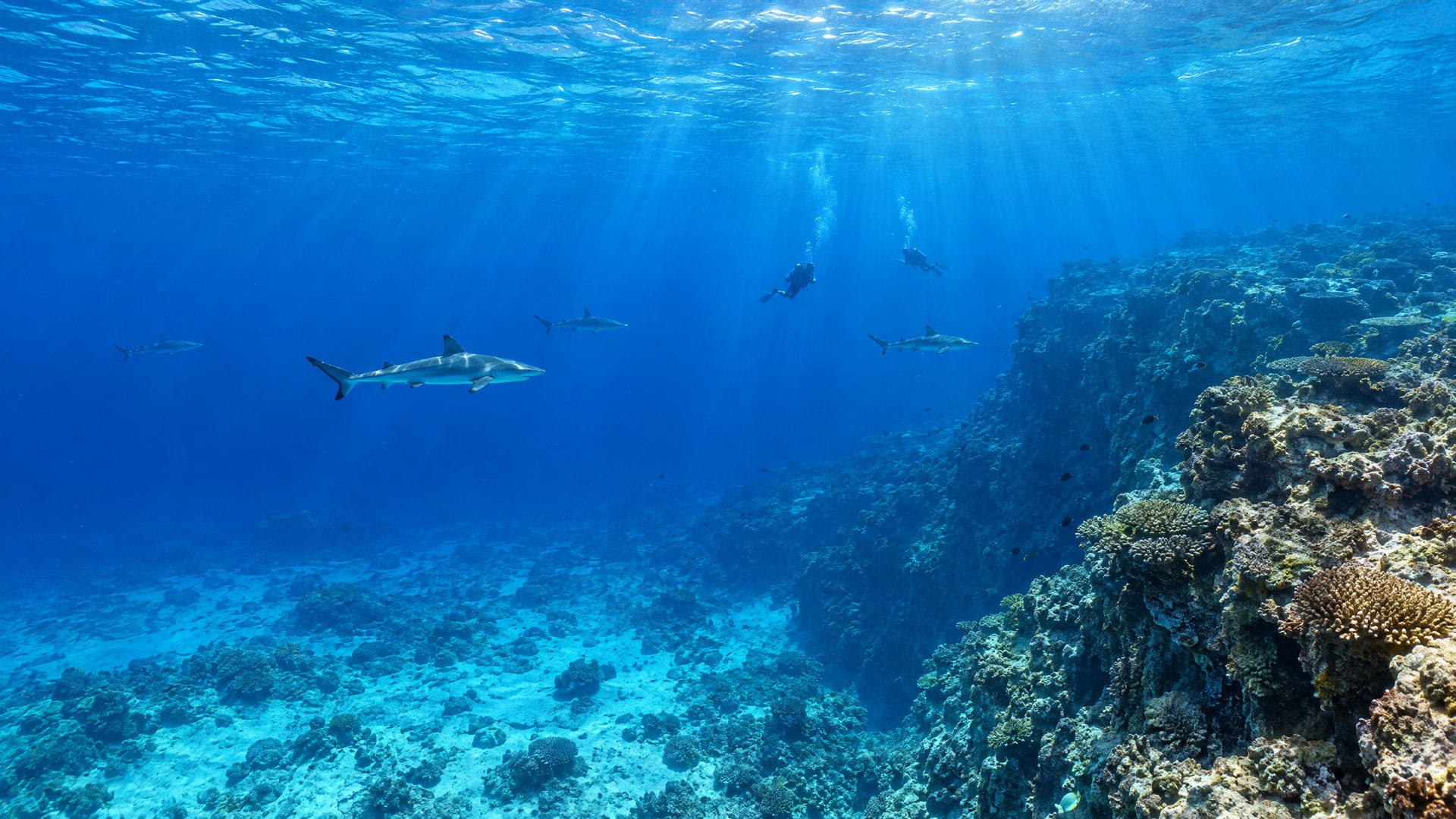
Experiences
Diving
Why the tide makes the theatre.
Read more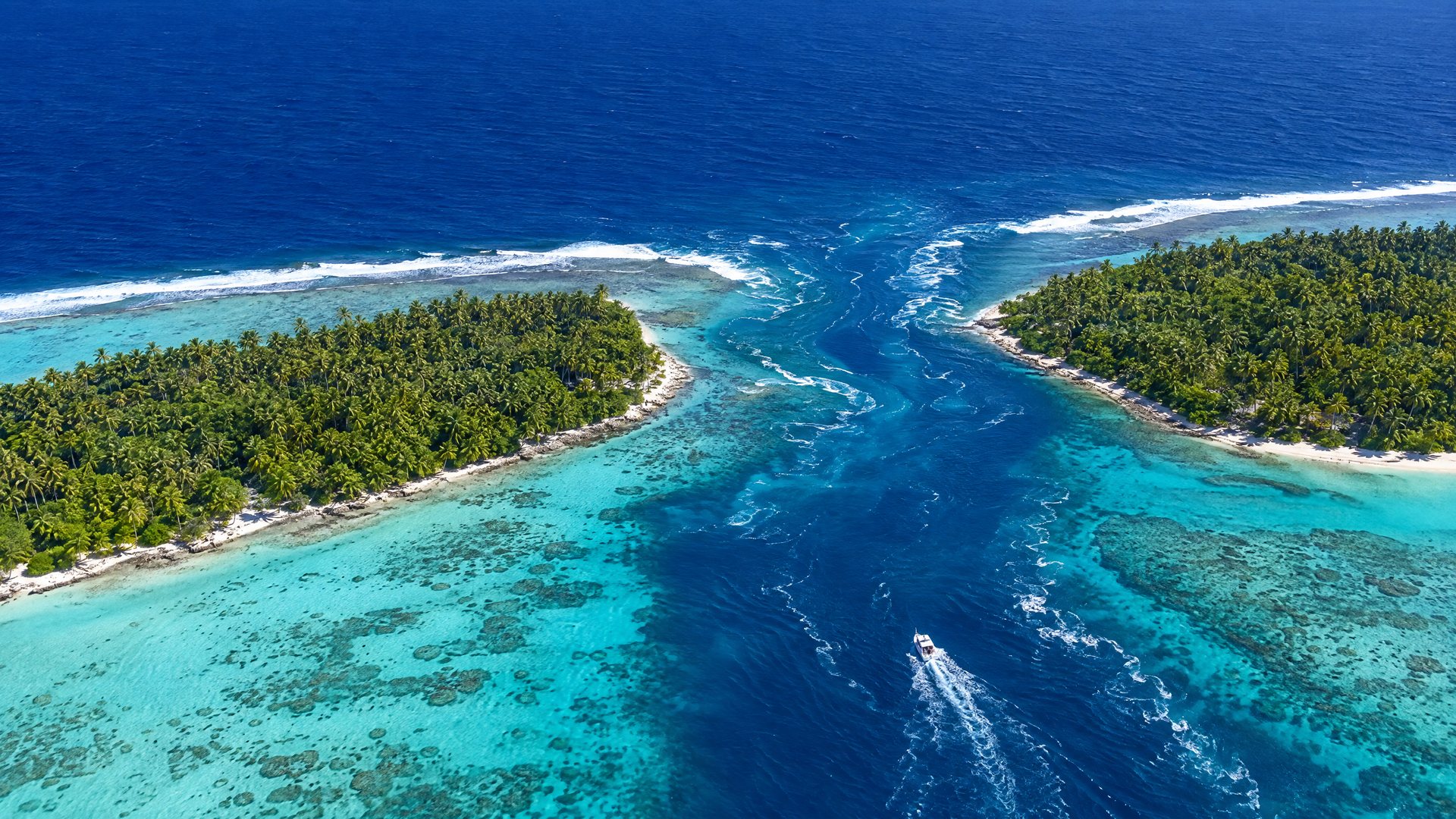
Tuamotu
Rangiroa
One of the largest atolls in the world. Pass diving, resident dolphins, a pearl farm and a vineyard.
Open the island guide