Society Islands · Leeward
Huahine,
two islands
in one lagoon.
Restored marae along a lake, blue-eyed eels in a village stream, surf passes, family pensions, and the first stop of the Leeward ferry.
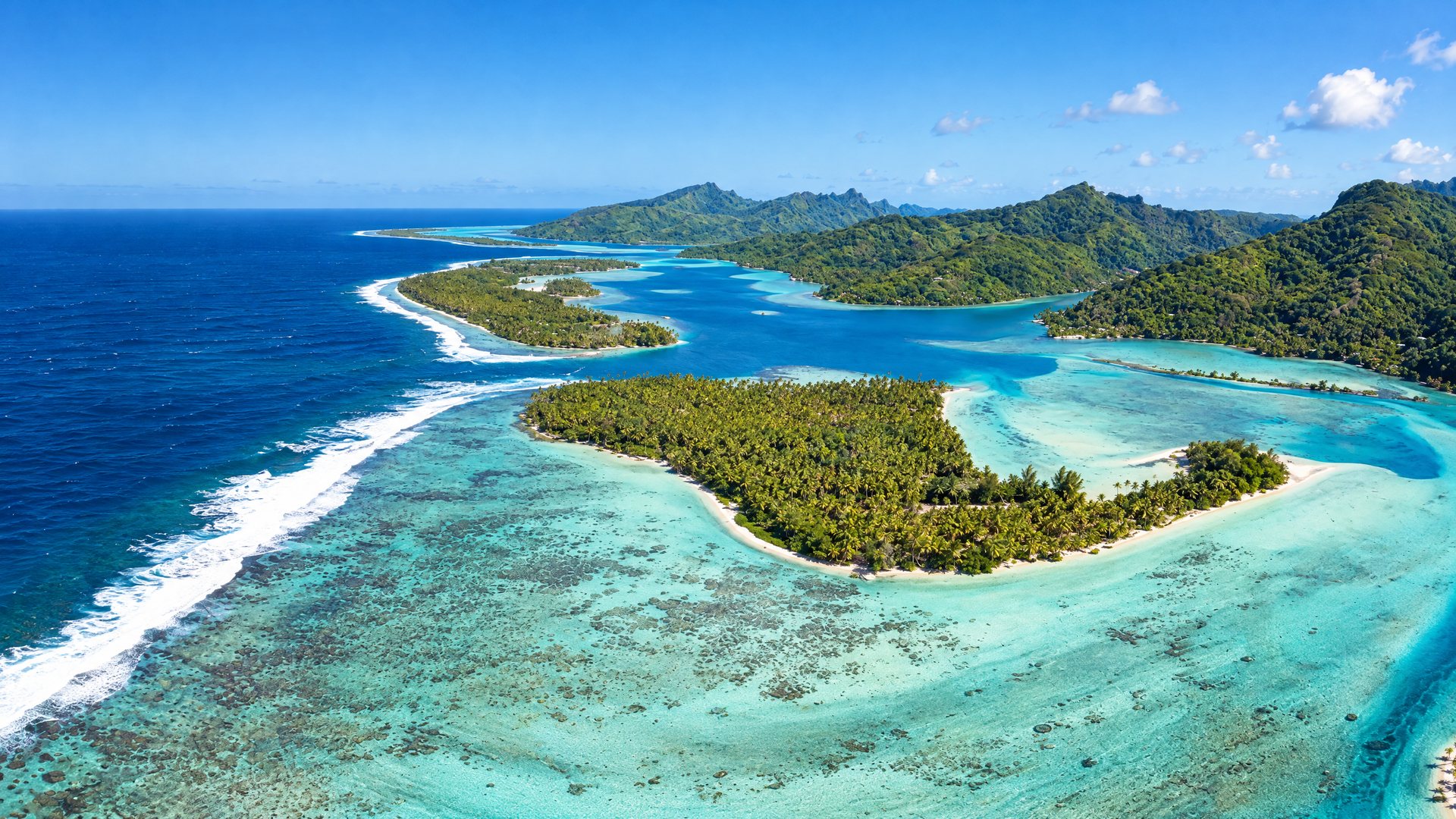
The pass into Huahine's lagoon
Huahine Nui and Huahine Iti sit inside a single reef, joined by a bridge at Maroe. Fare, the only real town, is two minutes from the airport and has everything, including the island's fuel stations. All of them. Fill up before you cross the bridge.
01 · History per kilometre
The shore
of shrines.
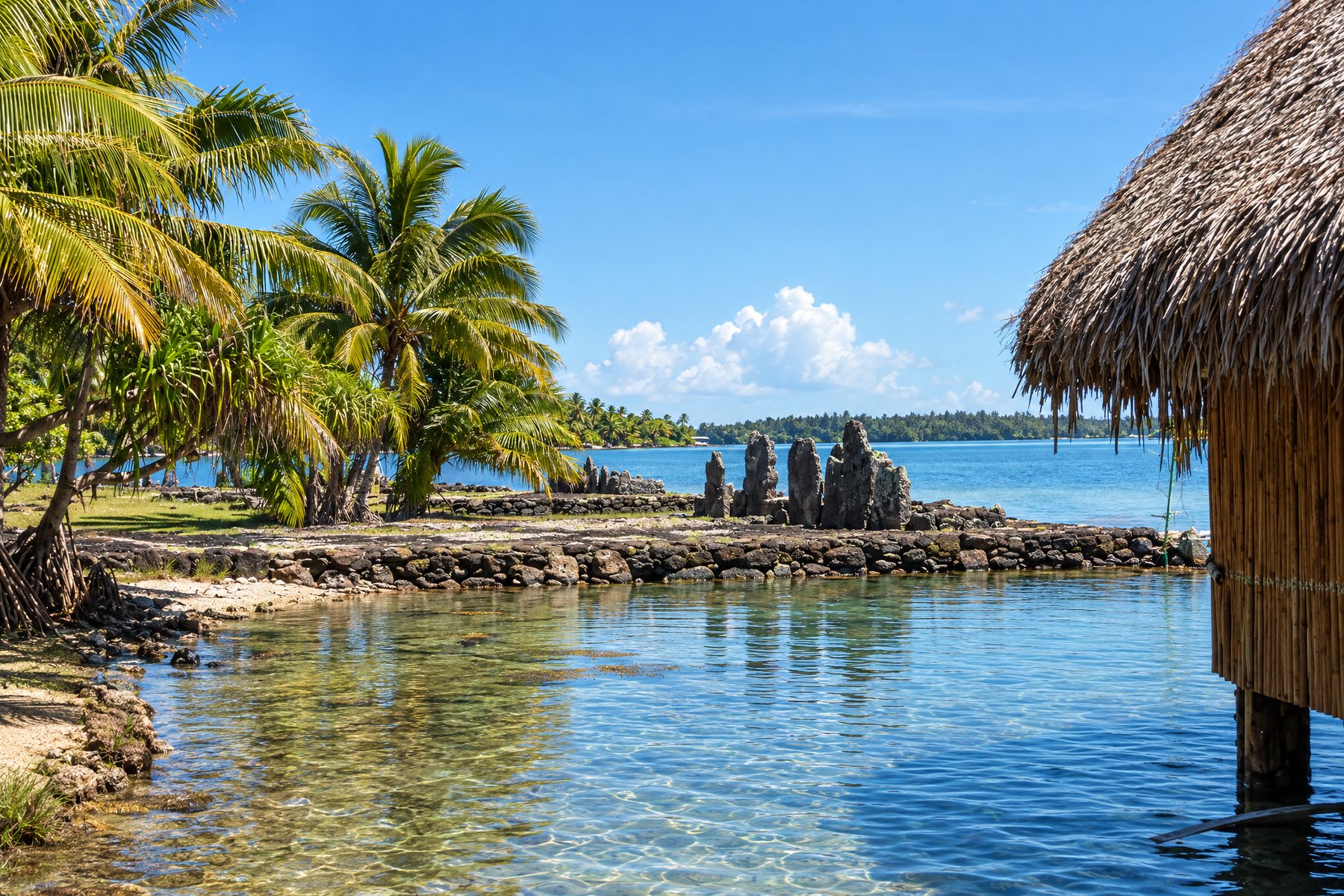
Along the shore of Lake Fauna Nui at Maeva, marae crowd the water's edge the way houses crowd a harbour. Fare Ro'i and O'ava'ura, the marae of the island's chiefly clans, were restored in 2023, and during the work a petroglyph of a double canoe turned up on one of the altar stones. The stone fish traps in the shallows below are still worked by the families who own them.
A trail of about 1.6 km climbs Matairea hill past more stone platforms to the summit marae, Mata'irea Rahi, whose three-metre retaining wall has partly collapsed. Keep off the stones. Back on the water, the rebuilt round-ended meeting house, Fare Pote'e, holds the finds from the excavations: Monday to Friday 8:30 to 15:30, Saturday mornings, cash only.
Across the bridge east of Maeva, Marae Manunu stands on the motu. The image of the god Tane was carried here by canoe for ceremonies between the tribes. It is the most accessible concentration of restored marae in the Leeward Islands, and most people drive past it on the way to lunch.
02 · Three places
A bay, a lake,
a stream.
Avea Bay
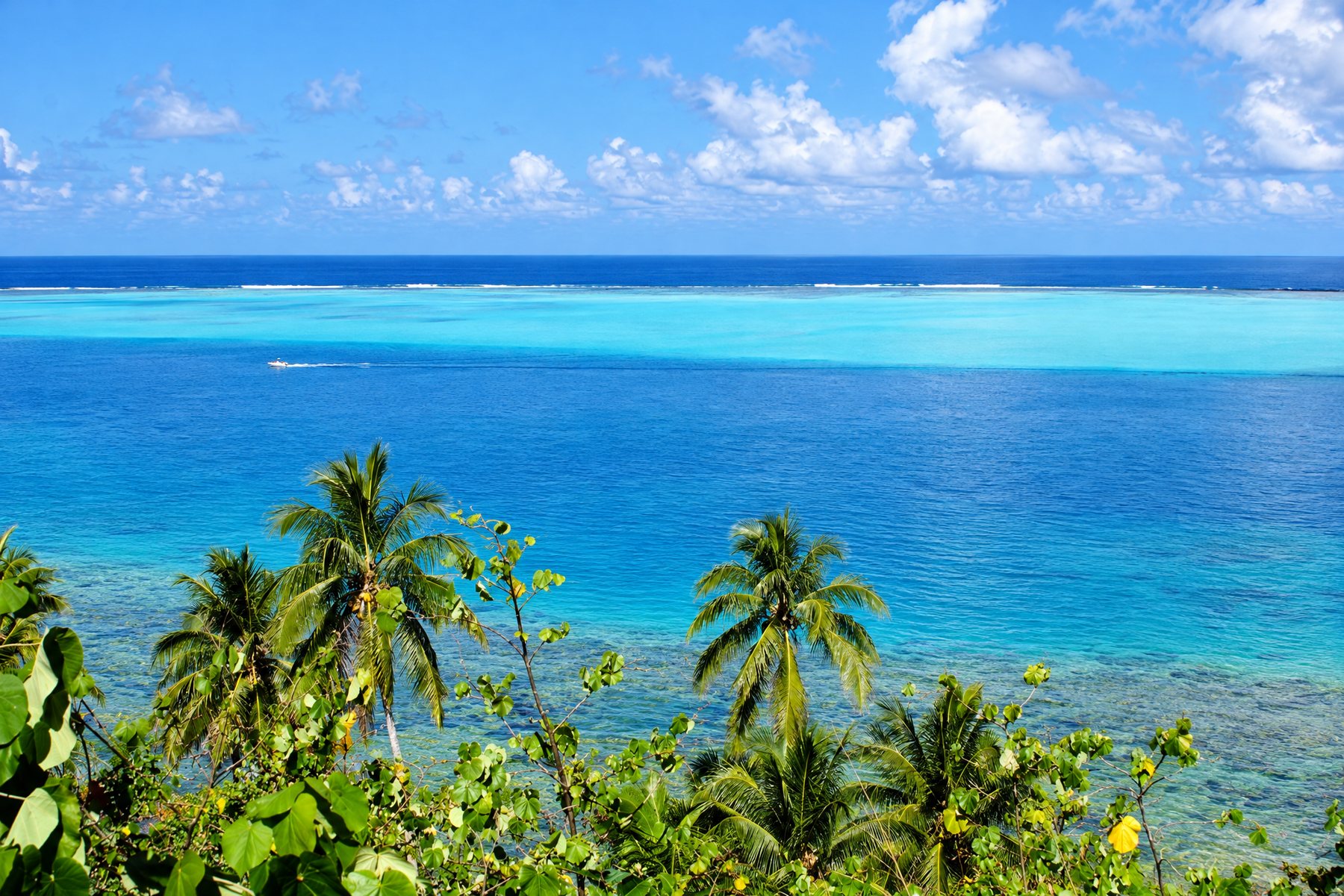
Several kilometres of sheltered sand on Huahine Iti's south-west, native trees behind it, the best swimming beach on the island. Le Mahana, one of the two hotels, sits on it with a coral garden off its pontoon.
Maeva
The marae along the lake and up the hill, the museum on the water, the fish traps. A half-day from Fare, better with somebody who tells the stories.
Faie
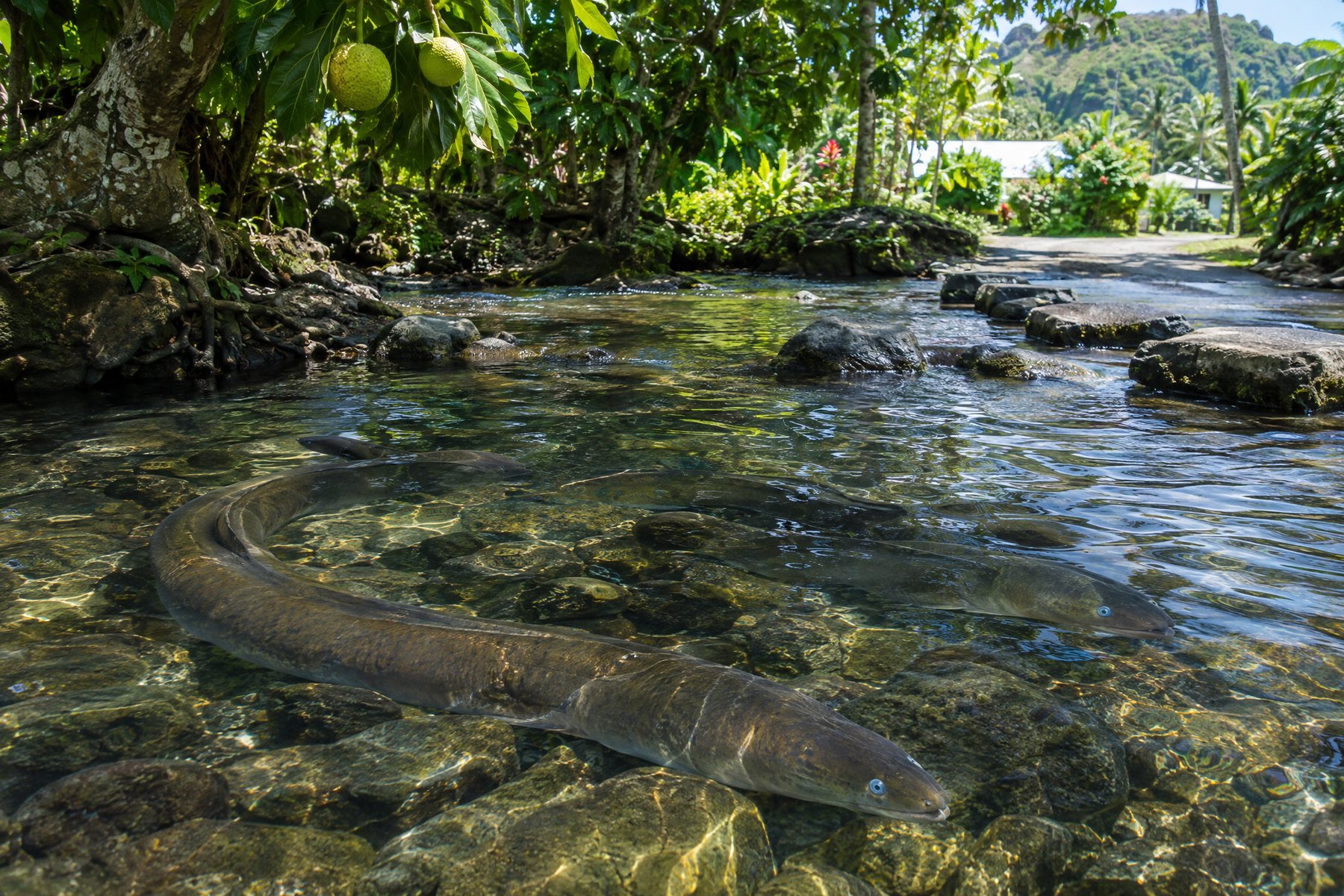
The eel stream on the east side, on the way round from Maeva. Free, five minutes, unforgettable.
03 · How to stay
Pensions,
not resorts.
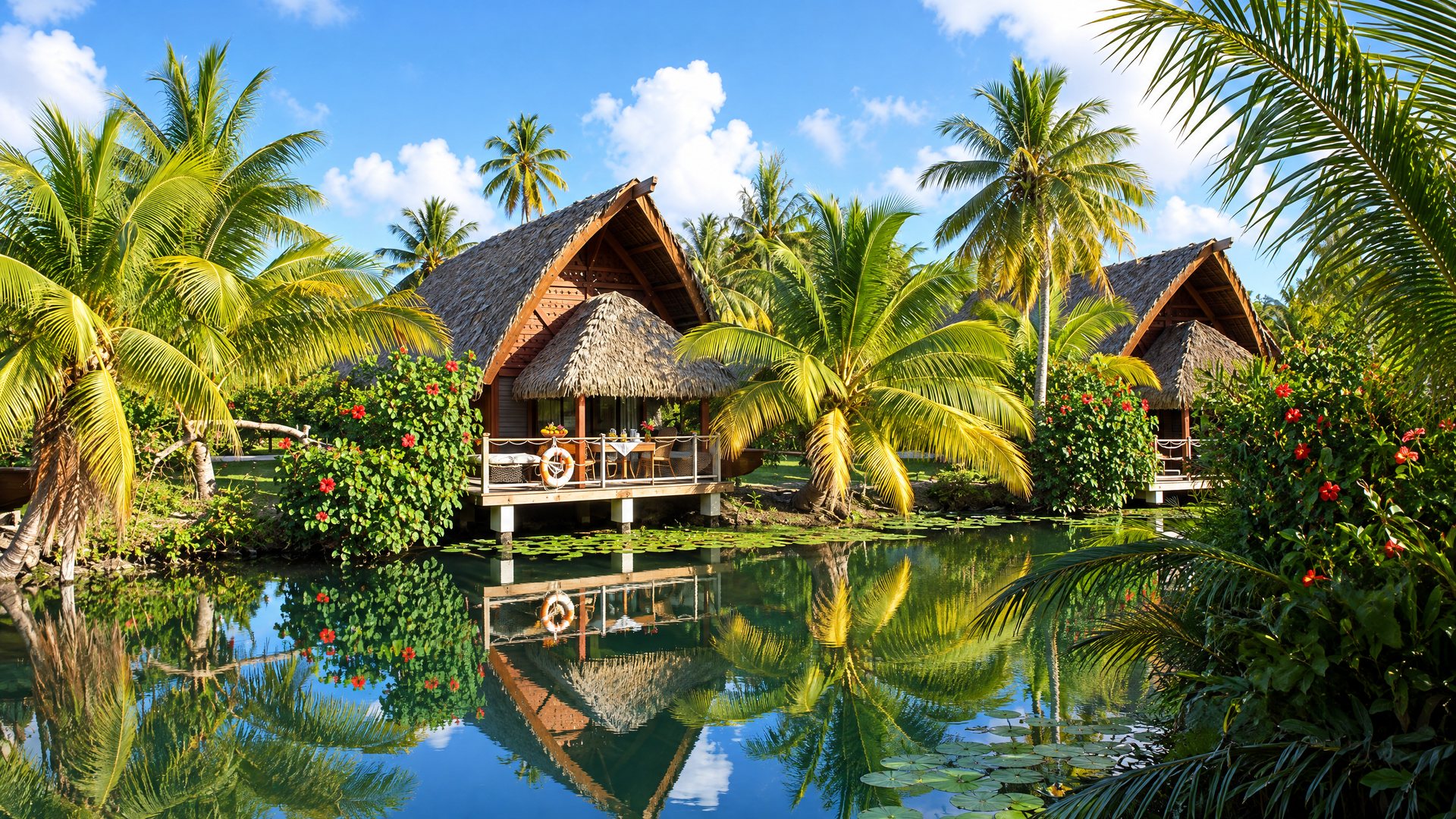
The Royal Huahine, the island's overwater hotel, has been closed since November 2021, and booking sites that still sell it are out of date. Two small hotels remain: Maitai Lapita Village, 32 garden bungalows and a pool on the edge of Fare, and Le Mahana, 33 air-conditioned bungalows on Avea Bay. Everyone else stays in family pensions. Pension Fare Maeva, by the sea 2 km from Fare, has bungalows with kitchens; Pension Poetaina has rooms in a colonial villa and bungalows on the motu; Chez Guynette in the middle of Fare has fan-cooled rooms for 6,500 XPF and dormitory beds for 3,000.
The water is for the experienced as well as the gentle. Fare's pass, Avamoa, has left and right reef breaks that fire in the southern winter, with a busy local line-up and a strong outgoing current. Fitii, south of Fare, is an exposed right that rarely sees a crowd. Divers go out with Mahana Dive, in Fare since 2002, or Pacific Blue Adventure: jacks and barracuda in the Avapehi pass, a gentle coral slope with blacktips at Fa'a Miti.
04 · Know before you go
The practical
part.
- Getting there
- Air Tahiti from Tahiti in about 40 minutes; 20 to 35 minutes from Bora Bora, Raiatea or Moorea. The Apetahi Express leaves Papeete at 06:30 on Tuesday, Friday and Sunday and reaches Fare at 09:40 for 8,000–9,000 XPF, then sails on to Raiatea, Taha'a, Bora Bora and Maupiti.Huahine is the ferry's first stop
- Getting around
- For Fare alone, feet. To see Maeva, Faie and Huahine Iti in a day, a car, scooter or e-bike. Rentals in Fare and Fitii. Le truck exists without a published timetable.Fuel only in Fare
- Rain
- A wet island. Fare averages close to 400 mm in each of December and January, and 140–200 mm a month even from July to September.Put the wet days on the lagoon side of the plan
- Money
- Banks and cash machines in Fare. Take cash for everywhere else.Pensions often want a deposit
- Eating
- Fare's waterfront: the Yacht Club for fish and sunsets, snack bars, fish sold at the quay, fruit stalls. Outside Fare, dinner is at your pension or Le Mahana; ask when booking.Buy vanilla from growers
- Best window
- July to September are driest and July the busiest. The island rewards a slower pace, not a checklist: three to five nights.Pair with Raiatea and Taha'a
05 · How to plan it
Four steps.
- 01
Land in Fare and stay there
Everything is walkable: the wharf, the shops, the banks, a beach a few minutes away.
- 02
Give Maeva a morning
The lake marae, the hill trail, the museum, then the eels at Faie on the way round.
- 03
Cross the bridge
Huahine Iti's quieter roads, Parea village and Avea Bay. Lunch at Le Mahana.
- 04
Let the rain happen
It will. Markets, a pension kitchen, a book, and a lagoon that is warm whatever the sky does.
06 · Who it does not suit
Very quiet.
There is no overwater bungalow to be had, the beaches are good but few, services are concentrated in Fare, and the island is asleep by ten. If that sounds like a problem, Moorea is busier and Bora Bora has the rooms. If it sounds like the point, Huahine has more history per kilometre than anywhere in the Leewards and fewer people on it.
07 · Who it suits
Who it
suits best.
Known for: Two islands, Nui and Iti, inside one lagoon · The Maeva marae on Lake Fauna Nui and Matairea hill · Blue-eyed eels in the stream at Faie · Reef-pass surf off Fare and Fitii · Pensions rather than resorts.
Independent travellers who like to drive or cycle a loop, stop where they please and talk to the people running the place. It suits anyone with an interest in Polynesian history — Maeva is the most accessible concentration of restored marae in the Leeward Islands — and experienced surfers and divers who don't need a resort to organise them. It is also the easiest first stop of a Leeward loop: first call of the ferry from Papeete, 40 minutes by air.
Typical stay: 3–5 nights. A day for the Maeva sites and the Faie eels, a day on the lagoon or diving, a day on Huahine Iti and Avea Bay, and slack for weather — the island rewards a slower pace, not a checklist.
08 · Getting there and around
Getting there,
getting around.
- International
- Every international flight lands at Faa'a (PPT) on Tahiti; Huahine has no international service. Leave a generous margin between the long-haul arrival and the domestic hop.1
- Domestic flights
- Air Tahiti flies Tahiti–Huahine (180 km) in about 40 minutes. Tahiti Tourisme gives 20 to 35 minutes for the flights from Bora Bora, Raiatea and Moorea, which makes Huahine an easy first or second stop on a Leeward loop.1
- Ferry
- The Apetahi Express leaves Papeete at 06:30 on Tuesday, Friday and Sunday and reaches Huahine at 09:40, then runs on to Raiatea (11:00), Taha'a, Bora Bora and Maupiti. Back to Papeete: leaves Huahine at 11:45 on Monday, Thursday and Saturday, arriving 15:00. A Wednesday shuttle links Huahine with the other Leewards only (timetable from 15 June 2026). Fares from Tahiti: 8,000 XPF (≈ US$78) one way in school term, 9,000 XPF (≈ US$88) in holidays, two 23 kg bags included, non-refundable.2
- Cruise ships
- Small cruise ships include Huahine on Society Islands itineraries — Paul Gauguin among them. Fare is small enough that a ship day is noticeable at the quay and on the road to Maeva.3
- Rental cars & scooters
- Tahiti Tourisme lists Avis Fare Nui Locations, Europcar Huahine and HCR Huahine Car Rentals; Fitii also has car and scooter rental. All the island's fuel stations are in Fare, so fill up before heading to Huahine Iti.1
- Bikes & e-bikes
- Bikes and e-bikes are rented on the island. The Fare–Maeva–Faie stretch is flat; the loop of Huahine Iti and the climbs between the bays are better on an e-bike or a scooter.1
- Le truck
- Tahiti Tourisme lists the open-sided 'truck' buses, but we found no published timetable; for the outer villages a rental is the realistic option.1
- Boats & kayaks
- Kayaks, paddleboards, outrigger canoes and skippered or bareboat yachts are all available; the motu and the coral gardens are reached by lagoon tour.1
09 · Where to stay
Which side
of the island.
Fare & the north-west. The wharf, the shops, the banks, the Yacht Club and most pensions, two minutes from the airport. Walkable and practical; there is a beach within a short walk. Best for: No-car stays, budget pensions, ferry and flight days.
Maeva & Faie. The marae along Lake Fauna Nui, the stone fish traps, Fare Pote'e and the Matairea trail, then the eel stream at Faie on the east side. Little accommodation; most people visit from Fare. Best for: History, half-day outings.
Huahine Iti & Avea Bay. The southern island: quieter roads, Parea village and Avea Bay's long beach, with Le Mahana hotel on it. Reached from Fare across the bridge at Maroe. Best for: Beach stays, swimming, slow days.
Maroe & Haapu. The deep bays where Nui meets Iti, with views from the belvedere above Maroe Bay. Villa rentals and family pensions rather than hotels. Best for: Self-catering villas, quiet.
10 · Accommodation
Beds,
by budget.
- Hotels
- Two operating hotels, both small. Maitai Lapita Village has 32 garden bungalows and a pool on the edge of Fare, 2.5 km from the airport; Le Mahana has 33 air-conditioned bungalows on Avea Bay's beach in the south, with a coral garden off its pontoon. The Royal Huahine (formerly Te Tiare Beach), the island's overwater hotel, has been closed since November 2021; a 2023 renovation plan aimed at reopening in December 2024, and we found no sign that it has — ignore booking sites still selling it. Examples: Maitai Lapita Village Huahine, Le Mahana Huahine.4
- Pensions & guesthouses
- Most visitors stay in family pensions, around Fare or along the bays. Pension Fare Maeva, by the sea 2 km from Fare, has 10 air-conditioned bungalows with kitchens and 5 rooms; Pension Poetaina, in Fare, has rooms in a colonial villa plus bungalows on the motu. Examples: Pension Fare Maeva, Pension Poetaina.5
- Budget
- Chez Guynette, in the middle of Fare and 100 m from the beach, is the island's long-running cheap bed: seven rooms with fans and private bathrooms, plus a dormitory; two-night minimum. Examples: Chez Guynette.66,500 XPF (≈ US$64) per room for one or two; dorm bed 3,000 XPF (≈ US$29) — undated rate sheet, checked 2026
11 · In the water
Beaches, reef
and open water.
- Avea Bay
- Several kilometres of sheltered sand on Huahine Iti's south-west, with native vegetation behind it; the best swimming beach on the island.7Beach
- Avapehi pass
- The pass off Fare. Tahiti Tourisme describes jacks from about 7 m, barracuda around 15 m, batfish and the occasional manta near 25 m, and a population of grey sharks. Current-driven: certified divers.8Diving
- Fa'a Miti
- A gentle coral slope sheltered from swell, wind and current, with blacktip sharks; suitable for all levels. Mahana Dive (in Fare since 2002) and Pacific Blue Adventure dive the Huahine sites, including the Fitii drop-off.8Diving
- Lagoon tours
- Day tours run to the motu, coral gardens and a picnic stop. Tahiti Tourisme lists Huahine Nautique and Matairea Lagoon Tour among the operators; ask whether the day includes Huahine Iti's side of the lagoon.9Lagoon
- Fare (Avamoa pass)
- Left and right reef breaks at the pass by the village, best in the southern-hemisphere winter on south-west swell. Shallow coral, strong outgoing current and a busy local line-up: for experienced surfers.10Surfing
- Fitii
- An exposed right-hand reef break south of Fare, most consistent in winter (June especially) on south-south-west swell; rarely crowded. Coral, urchins and sharks come with it.11Surfing
12 · On land
Ashore,
between swims.
- 01
Maeva marae
Archaeology. Marae line the shore of Lake Fauna Nui at Maeva. Fare Ro'i and O'ava'ura, marae of the supreme chiefs of the island's eight clans, were restored by the Direction de la culture et du patrimoine in mid-2023, when a double-canoe petroglyph turned up on O'ava'ura's ahu; Rauhuru was restored in December 2022. On the hill above, the retaining wall of Mata'irea Rahi, nearly 3 m high, has partly collapsed — keep off the stones.12
- 02
Matairea hill
Hike. A trail of about 1.6 km climbs Matairea hill past further stone structures to Mata'irea Rahi, the summit marae. Go early: it is shaded in parts but humid.3
- 03
Fare Pote'e
Museum. A rebuilt round-ended meeting house on the water at Maeva, restored in 1972, with finds from the local excavations. Open Monday–Friday 8:30–15:30 and Saturday 9:00–11:00 (2026 listing); cash only.13
- 04
Marae Manunu
Archaeology. On the motu across the bridge east of Maeva. The image of Tane was carried here by sacred canoe for the intertribal ceremonies.12
- 05
Faie eels
Culture. Blue-eyed puhi tari'a eels, up to 2 m long, live in the stream that crosses the road in Faie village. They are sacred locally; look, don't handle. Free.14
13 · Food and shopping
What to eat,
and where.
Dining centres on Fare: the waterfront, the snack bars and the fresh fish sold at the quay. The two hotels have the island's only resort-style restaurants, and many pensions cook dinner for guests — ask when booking, because outside Fare evening options thin out fast. Self-catering is easy: Fare has shops and fruit and vegetable stalls. Order poisson cru, and buy vanilla direct from growers.
Shopping. Fare has the boutiques and the market stalls; vanilla, fruit and pareos are the local buys. Pearls are sold, but they are not a local crop — most come from the Tuamotu and Gambier, with a few farms in the Leewards, mainly on Taha'a. Compare prices in Papeete before spending seriously.
14 · Trip styles
One island,
several trips.
- Families
- Works well with a car. Avea Bay and the beach near Fare are calm for swimming, the eels at Faie and the fish traps at Maeva hold children's attention, and pension bungalows with kitchens keep costs down. The surf passes and outer-reef dives are for adults.
- Honeymoons
- Fine if the point is quiet rather than overwater. Le Mahana's beach bungalows on Avea Bay are the closest thing to a resort stay; pair Huahine with Bora Bora for the overwater nights.
- On a budget
- One of the better Leeward islands for it. Take the Apetahi Express from Papeete, stay in Fare, rent a bike, eat from the quay and the snack bars, and spend on one lagoon tour.
- Nightlife
- There is none to speak of: a sunset drink at the Yacht Club or a hotel bar, and the island is asleep by ten.
15 · Weather by month
Month by month.
January
31° / 24° · sea 29°
Rain about 395 mm. Crowds low, prices low.
February
31° / 24° · sea 29°
Rain about 287 mm. Crowds low, prices low.
March
32° / 24° · sea 29°
Rain about 263 mm. Crowds low, prices low.
April
32° / 24° · sea 29°
Rain about 258 mm. Crowds moderate, prices moderate.
May
31° / 23° · sea 28°
Rain about 247 mm. Crowds moderate, prices moderate.
June
30° / 23° · sea 28°
Rain about 202 mm. Crowds moderate, prices moderate.
July
30° / 22° · sea 27°
Rain about 140 mm. Crowds peak, prices high.
August
29° / 22° · sea 27°
Rain about 148 mm. Crowds high, prices high.
September
30° / 22° · sea 27°
Rain about 203 mm. Crowds moderate, prices moderate.
October
30° / 23° · sea 27°
Rain about 260 mm. Crowds moderate, prices moderate.
November
31° / 23° · sea 28°
Rain about 261 mm. Crowds low, prices low.
December
31° / 24° · sea 28°
Rain about 394 mm. Crowds moderate, prices moderate.
Fare (Météo-France station 98724001) — monthly means for 1991–2019 computed by us from Météo-France's open monthly data (no official 1991–2020 climate sheet is published for Huahine)17. Sea temperature18. Crowds and prices are editorial scores (1 = low, 5 = high). Crowds follow ISPF's 2024 monthly tourist-nights curve for French Polynesia (lowest January–February and November, peak July, high June and August–October) plus French Polynesian school holidays; price swings are smaller than on Bora Bora because most beds are in pensions..
16 · Trip length
How long,
and with what.
Three to five nights. Huahine is the natural first stop of a Leeward loop: the Apetahi Express calls here first out of Papeete and continues to Raiatea an hour later, then Taha'a, Bora Bora and Maupiti, so a Tahiti–Huahine–Raiatea/Taha'a–Bora Bora route can be done largely by boat. By air, Huahine links directly to Bora Bora, Raiatea and Moorea. Put the wettest-looking days on the lagoon side of the plan; on Huahine they arrive often.
17 · Huahine vs Moorea
Huahine
or Moorea?
- Getting there
- Huahine: 40-min flight, or 3 h 10 by ferry three times a week19
Moorea: 25–45 min by ferry from Tahiti, several times a day20 - Where you sleep
- Huahine: Two small hotels and pensions; the overwater hotel is closed23
Moorea: More hotels, including international resorts with overwater rooms - History
- Huahine: Maeva: marae on the lake and on Matairea hill, plus a museum12
Moorea: Opunohu valley marae - Pace
- Huahine: Fare is the only real town; evenings are short
Moorea: Busier roads, more restaurants, day-trippers from Tahiti
Verdict. Moorea if time is short and you want variety within reach of Papeete; Huahine if you have the days for a slower island with more history per kilometre and fewer people on it. The Moorea guide
18 · Questions
Asked
before booking.
- 01
Is the Royal Huahine open?
No. The hotel (formerly Te Tiare Beach) closed in November 2021; a 2023 plan to renovate and reopen it under a new name has not, as far as we can find, materialised. Booking sites that still list it are out of date.
- 02
Do I need a car?
For Fare alone, no. To see Maeva, Faie and Huahine Iti in a day, yes — or a scooter or e-bike. Fill up in Fare: all the island's fuel stations are there.
- 03
Can I take the ferry from Tahiti?
Yes. The Apetahi Express sails Papeete–Huahine on Tuesday, Friday and Sunday (06:30–09:40) and back on Monday, Thursday and Saturday; one way costs 8,000–9,000 XPF (≈ US$78–88) depending on school holidays.
- 04
Is there an ATM?
Yes, in Fare: the banks there have cash machines. Elsewhere on the island, take cash.
- 05
When is the best time to go?
July to September is driest, though even then Fare averages 140–200 mm a month; December and January are very wet (close to 400 mm). July is the busiest month.
Sources · last verified 14 October 2026(35)
- Tahiti Tourisme: Huahine — getting there and getting around ↗
- Tuatea Ferries / Apetahi Express: Horaires Apetahi Express à partir du 15 juin 2026 ↗
- Paul Gauguin Cruises: Cruises visiting Huahine, Society Islands (Matairea trail one mile) ↗
- Tahiti Tourisme: Maitai Lapita Village Huahine (32 bungalows; open 2026; updated 14 May 2025) ↗
- Tahiti Tourisme: Pension Fare Maeva (open 2026; updated 29 Nov 2024) ↗
- Chez Guynette: Pension Chez Guynette — les tarifs (undated) ↗
- Tahiti Tourisme: Plage de Avea (updated 8 Mar 2023) ↗
- Tahiti Tourisme: Diving in Huahine (Avapehi, Fa'a Miti; Pacific Blue Adventure, Mahana Dive) ↗
- Tahiti Tourisme: Huahine — island page (area 75 km², operators, points of interest) ↗
- Surf-Forecast: Fare Left surf break guide (third-party; no official source found) ↗
- Surf-Forecast: Fitii surf break guide (third-party; no official source found) ↗
- Direction de la culture et du patrimoine: Fare Ro'i et O'ava'ura à Huahine : préserver leur architecture originale (Hiro'a n° 189, Sep 2023) ↗
- Tahiti Tourisme: Fare Pote'e de Maeva (opening hours 2026) ↗
- Tahiti Tourisme: Anguilles sacrées de Faie (updated 7 Mar 2023) ↗
- Tahiti Tourisme: Huahine Yacht Club (updated 17 Apr 2023) ↗
- Tahiti Tourisme: Mahana Huahine (33 bungalows, Avea Bay; open 2026; updated 10 Nov 2025) ↗
- Météo-France (via data.gouv.fr): Données climatologiques de base mensuelles — Polynésie française (MENSQ_987, 1950–2024), station FARE 98724001; 1991–2019 means computed by Polynesian Compass ↗
- seatemperature.info: Huahine water temperature — monthly averages (aggregator) ↗
- Air Tahiti: Huahine — flight duration 0h40, distance 180 km (figures from the airline's indexed page; the page blocks automated access) ↗
- Tahiti Tourisme: Moorea — island page (133.5 km², 25–45 min by ferry) ↗
- ISPF: Recensement de la population 2022 — populations légales par commune et commune associée ↗
- ISPF: Recensement de la population 2022 — populations légales (incl. Moorea-Maiao 18,201) ↗
- Tahiti Tourisme: Hotels on Huahine (Maitai Lapita Village, Mahana Huahine) ↗
- ISPF: Le bilan du tourisme de l'année 2024 (Points Études et Bilans n° 1489) — monthly tourist nights ↗
- Tuatea Ferries / Apetahi Express: Tarifs Apetahi Express (période scolaire / vacances) ↗
- Tahiti Tourisme: Huahine — practical information ↗
- Tahiti Tourisme: Where are The Islands of Tahiti? (time difference) ↗
- Tahiti Tourisme: Site archéologique de Maeva (free, open daily 2026; updated 21 Oct 2024) ↗
- Tahiti Tourisme: Mont Turi (669 m) ↗
- Mahana Dive: Mahana Dive — Fare, Huahine (since 2002) ↗
- Radio1 Tahiti: Un nouveau plan pour rouvrir le Royal Huahine ? (19 Sep 2023 — closed since November 2021) ↗
- Le Mahana: Hôtel Le Mahana — Avea Bay, Parea (3-star) ↗
- Tahiti Tourisme: Pension Poetaina (updated 23 Jul 2024) ↗
- Tahiti Tourisme: Chez Guynette (7 units, Fare) ↗
- IEOM: La perliculture en Polynésie française (Études thématiques n° 309, Sep 2020) ↗
Related
Related pages.
Explained
The blue-eyed eels of Faie
Freshwater eels up to two metres long, with pale blue eyes, in a village stream on Huahine.
Read the article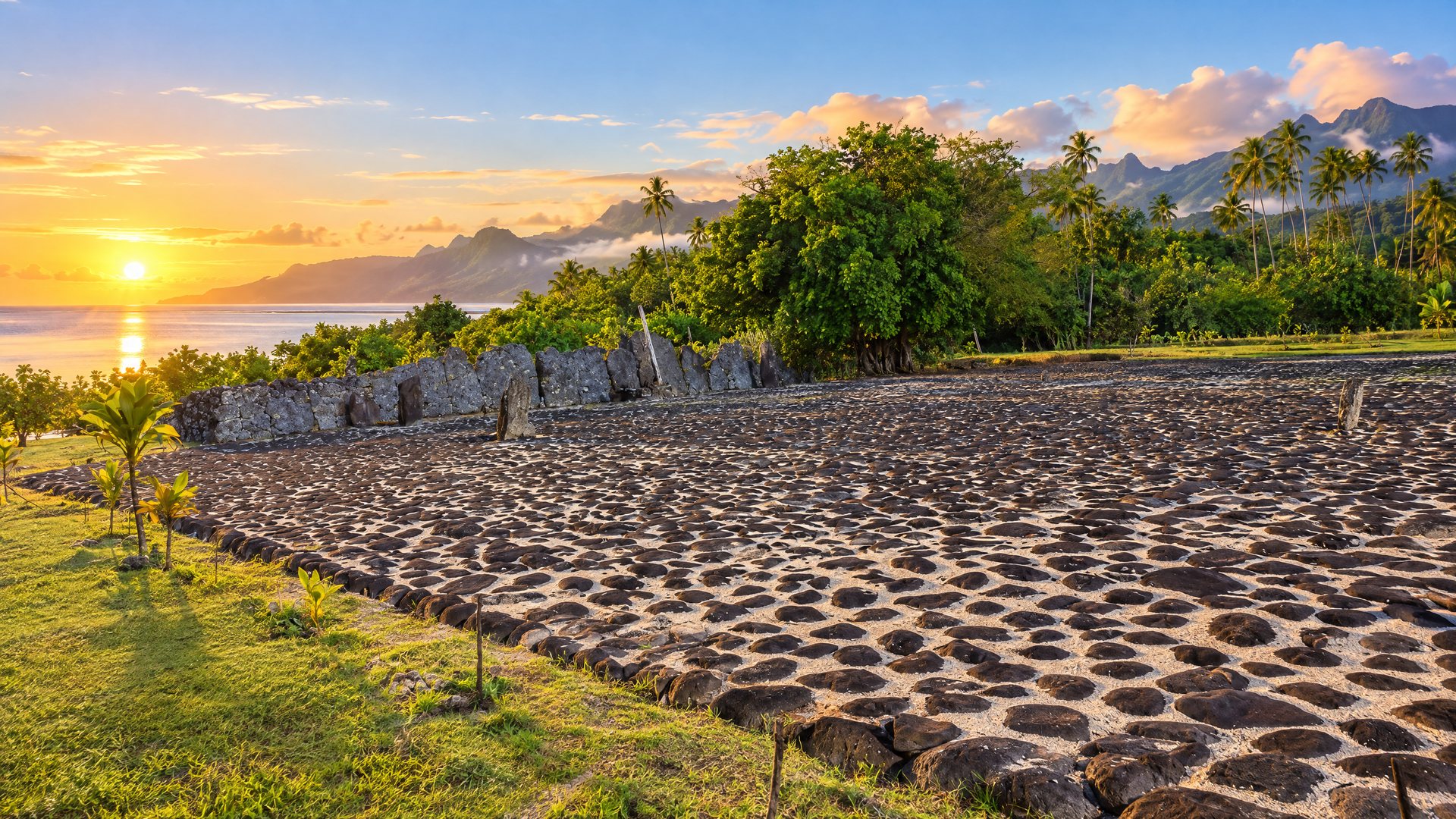
Culture
Marae
How to read a stone court, and how to visit one with the respect it is owed.
Read moreStay
Pensions
The islands' front door: what to expect and how to book.
Read more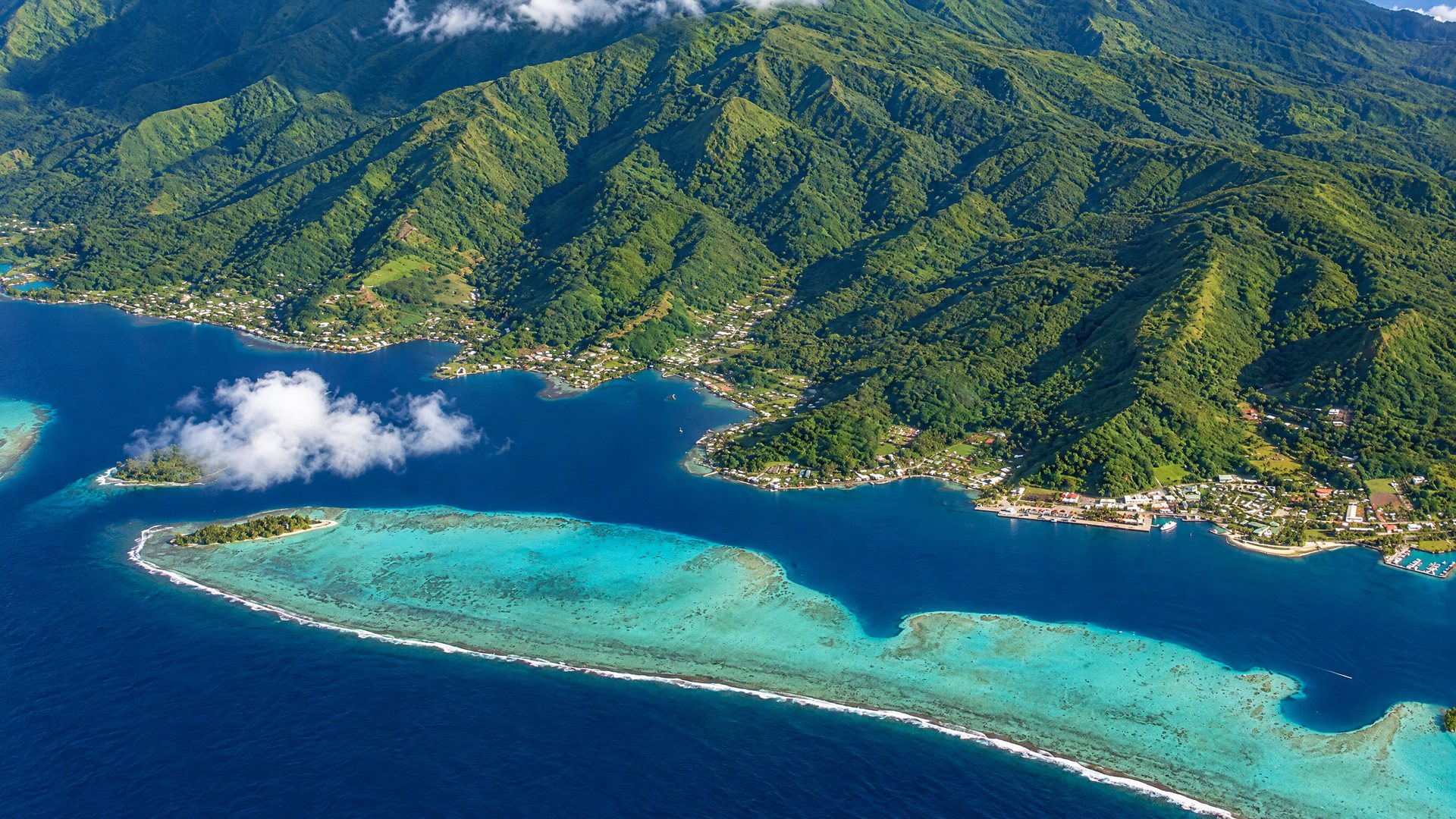
Society Islands
Raiatea
Taputapuātea, the World Heritage marae, and the base for most sailing charters.
Open the island guide